Wallet Drainer Protection: Stop Crypto Wallet Drain Attacks Before They Happen

Wallet drainer attacks are the fastest-growing threat in Web3. Attackers don't need your private key — they trick you into signing transactions that hand over your funds in seconds. This guide explains exactly how wallet drain attacks work, why conventional security tools don't stop them, and how pre-transaction simulation blocks them before funds move.
Book a Demo

~$80M

USR illegally minted

~$25M

Extracted by the attacker

~70%

USR price depeg

What Is Wallet Drainer Protection?

Wallet drainer protection refers to security systems that detect and block malicious transactions, approvals, or signatures before they can empty a crypto wallet. The most effective solutions analyze transactions before signing, detect malicious smart contract behavior, and block or flag high-risk interactions in real time — before any funds leave the wallet.
What is a wallet drainer? A wallet drainer is a type of attack that tricks users into signing transactions that grant attackers access to their funds. Unlike traditional hacks, wallet drainers require no private key compromise — they exploit user approvals and signatures, executing instantly once permission is granted.
What is a token approval exploit? A token approval exploit occurs when an attacker tricks a user into granting unlimited or broad spending rights over their tokens. Once approved, the attacker's contract can drain the wallet at any time without further interaction from the victim.
What is permit phishing in crypto? Permit phishing uses the EIP-2612 permit standard — which allows token approvals via off-chain signatures — to trick users into signing a message that looks harmless but grants an attacker full spending rights over their tokens without any on-chain approval transaction.

How Wallet Drainer Attacks Work

Stage 1: Phishing or Fake dApp
The attacker creates a convincing entry point — a fake airdrop, a spoofed NFT mint page, a fraudulent protocol link distributed via Discord, Twitter DMs, or search ads. The goal is to get the victim to connect their wallet.
Stage 2: Wallet Connection
The victim connects their wallet. At this point no funds have moved, but the attacker's contract is now in the loop.
Stage 3: Malicious Approval or Signature
The victim is prompted to sign a transaction. This may look like a routine approval but contains hidden permissions — an unlimited token allowance, a Permit signature granting spending rights, or a contract call that transfers assets directly.
Stage 4: Automated Drain
The moment the signature is submitted, the attacker's contract executes. Funds are swept to attacker wallets in a single transaction. The entire sequence from signature to drain can complete in under 30 seconds.
The core problem: the user authorized the attack. The blockchain treated it as a valid transaction.

What can transaction simulation detect?

Request a demo

Unexpected token transfers

Token movements not present in the transaction's stated intent — including transfers to unexpected addresses, unauthorised approval consumption, or abnormal transfer volumes relative to the transaction type.

Unauthorised state changes

Smart contract storage modifications that deviate from expected behavior — including changes to ownership variables, access control settings, or protocol configuration parameters.

High-risk address exposure

Execution paths that route through addresses associated in risk intelligence datasets with sanctions exposure, exploit activity, or other elevated risk — including indirect interactions within supported environments.

Reentrancy-consistent call patterns

Execution traces where the same contract function is called recursively within a single transaction — a pattern structurally consistent with reentrancy attacks and warranting closer review regardless of stated intent.

Abnormal gas consumption

Gas usage disproportionate to the transaction's apparent function — often indicating that complex hidden logic is executing inside what appears to be a simple call.

Oracle manipulation setup patterns

Execution paths that include price-sensitive reads from oracle or AMM pool contracts immediately after a large liquidity movement — a pattern consistent with oracle manipulation setups.

Flash loan interaction patterns

Transactions that borrow and repay within the same execution — particularly those involving large amounts relative to pool liquidity combined with price-sensitive contract calls.

Cross-contract dependency chains

Deep call graphs involving multiple protocols in sequence — bridges, DEXs, lending protocols, liquidity pools — that create complex execution dependencies and expand the risk surface of a single transaction.

Approval and allowance manipulation

Token approval transactions granting unexpectedly large or unlimited spending permissions to contracts or addresses that do not match the transaction's stated purpose.

What is the difference between transaction simulation and transaction monitoring?

Transaction simulation and transaction monitoring are complementary capabilities that operate at different points in the transaction lifecycle. The distinction matters because they address different risks.
The one-line distinction: Simulation prevents. Monitoring detects.

Capability

Transaction monitoring

Transaction simulation

When it operates
After transaction is confirmed on-chain
Before transaction is broadcast to network
Primary use
Detect suspicious patterns in historical / real-time data
Evaluate execution risk before irreversible confirmation
Can prevent transactions
No — transaction already confirmed
Yes — intervention window exists pre-broadcast
Data source
On-chain transaction records
Live blockchain state + transaction parameters
Coverage
All confirmed transactions
Transactions routed through simulation layer
Best for
Investigation, audit support, post-incident analysis
Pre-execution risk enforcement, exploit prevention
Complements
Simulation (catches what simulation misses post-hoc)
Monitoring (prevents what monitoring can only detect)
The practical implication: transaction monitoring tells you what happened. Transaction simulation tells you what will happen — and gives you the ability to stop it. For organisations where the cost of a single bad transaction is high — exchanges processing large withdrawals, custodians handling institutional assets, DeFi protocols with significant TVL — simulation is the difference between prevention and incident response.

Use cases by team

Request a demo

Security operations teams

Simulate high-value or anomalous transactions before they are processed. Surface hidden execution paths, unexpected contract interactions, and risk signals that transaction parameters alone do not reveal. Feed simulation outputs into incident response and compliance workflows.

Exchange operations (CEX)

Simulate customer withdrawal transactions before processing to identify unexpected token routing, interactions with flagged contracts, or execution patterns inconsistent with stated transaction intent. Apply automated verdicts to high-risk simulations within configured workflows.

Custodians

Simulate outbound transactions from custodied wallets before authorisation. Identify unexpected counterparty interactions, unauthorised state changes, and token movements that deviate from client instructions before funds move.

DeFi protocol teams

Simulate transactions submitted to your protocol before execution. Identify manipulation-consistent patterns, reentrancy-consistent call structures, flash loan setups, and oracle price manipulation patterns before they execute against your contracts.

Infrastructure

Offer pre-broadcast simulation as a capability to downstream clients via API. Surface execution risk at the infrastructure layer without clients needing to build their own simulation engine.

Compliance teams

Use simulation outputs as evidence in compliance workflows — demonstrating that transactions were evaluated for risk before processing. Simulation logs support auditable documentation designed to align with regulatory reporting workflows and internal governance requirements.

Why is transaction simulation important for DeFi?

DeFi protocols involve chains of smart contract interactions — flash loans, liquidity pool operations, oracle reads, cross-protocol calls — that can behave entirely differently under different input conditions. A transaction that looks innocuous from its parameters can execute a complex multi-step sequence when it reaches the execution environment.
This is why static analysis of transaction parameters is insufficient for DeFi security. The risk is not in the parameters — it is in the execution path they trigger.
Transaction simulation traces the full execution path of DeFi transactions within supported environments before they run. For common DeFi attack types, simulation can surface characteristic patterns — though no simulation approach captures every possible exploit scenario:
Flash loan attacks
Flash loan transactions borrow large amounts, execute logic, and repay within a single transaction. Simulation can reveal the full execution sequence — the borrow, the logic, the repay — and can flag transactions where price-sensitive contract reads occur between the borrow and the repay, consistent with flash loan attack patterns.
Oracle manipulation
Oracle manipulation attacks inflate or deflate an asset's price in a low-liquidity market before triggering a price-dependent operation in a target protocol. Simulation can identify the pattern: large liquidity movement followed by an oracle read and a price-sensitive contract call.
Reentrancy
Reentrancy attacks exploit functions that call external contracts before updating their own state. Simulation traces the call graph and can identify recursive entry patterns — the same function called multiple times within a single execution — structurally consistent with reentrancy exploits and warranting review.
Governance attacks
Governance attacks accumulate voting power and submit proposals designed to drain treasuries or modify critical protocol parameters. Simulation of governance transactions can reveal proposals that would grant unexpected permissions or result in state changes inconsistent with normal governance activity.

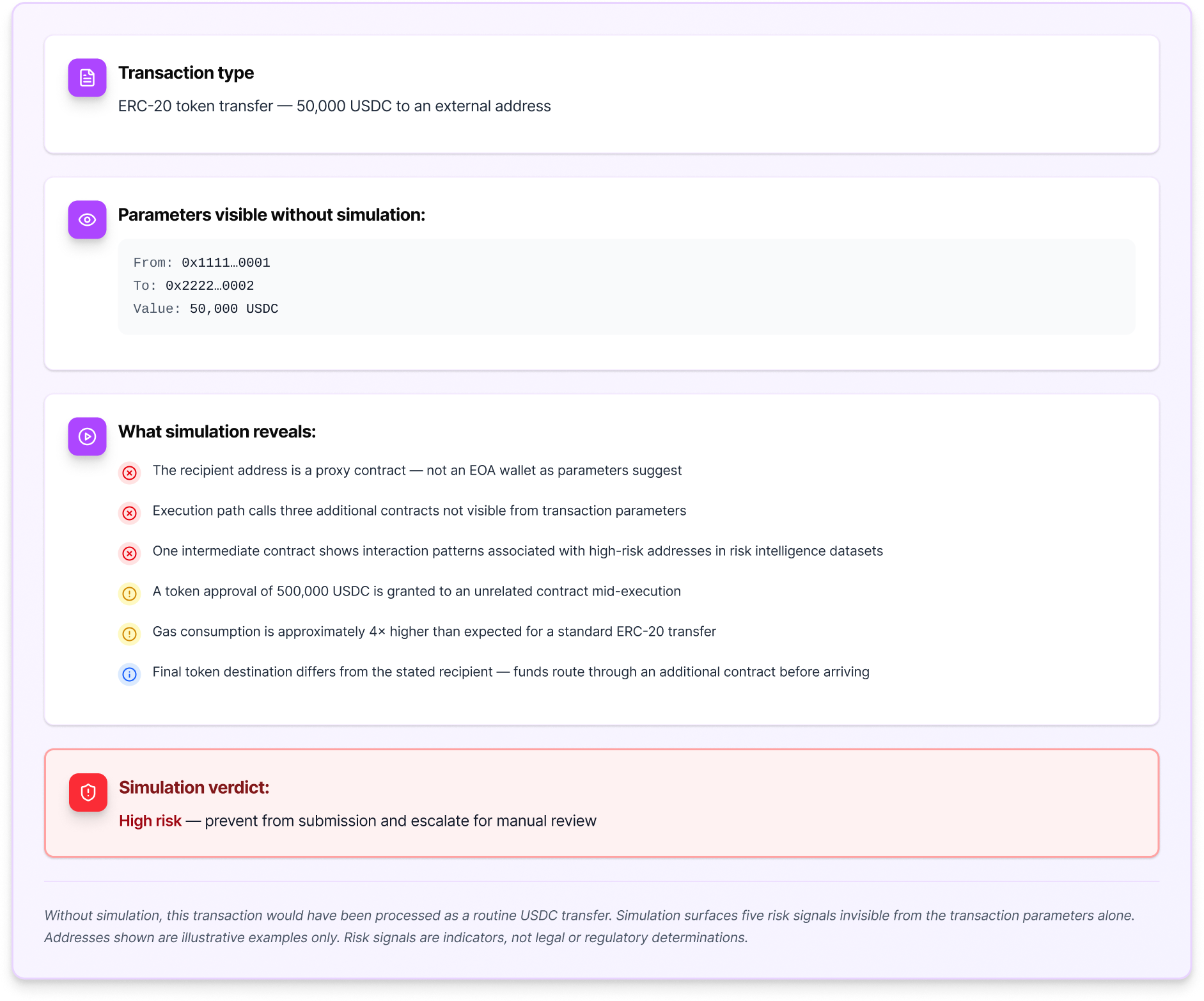
Example: what simulation surfaces before execution

Here is a concrete illustrative example of what address poisoning monitoring and pre-broadcast screening can surface for an outbound transfer that would otherwise appear routine. All addresses and figures shown are entirely fictional and are not based on any real organisation or incident.
This example shows why address poisoning is so effective against teams that rely on visual verification alone. A full address with a matching prefix and suffix looks identical to the legitimate address in every interface that truncates the middle. Verification must be systematic, not visual.

Why Web3Firewall for transaction simulation

Request a demo
Web3Firewall is a Web3 security and compliance platform — often described as a SIEM for blockchain. It is designed for operational teams who need risk decisions at machine speed, not developers running batch analyses in staging environments.
Most transaction simulation tools were built for developers — useful for testing contract behavior but not designed to operate as a live enforcement layer. Web3Firewall's simulation engine was built for operations: it runs on transactions routed through the platform in near real time, feeds into an automated verdict system, and integrates with compliance workflows designed to support controls relevant to MiCA-oriented compliance workflows, NIST, and OWASP frameworks.
Transactions routed through Web3Firewall are simulated before broadcast within supported environments. The simulation output feeds a real-time verdict — allow, deny, or require approval — that enforces policy decisions before the transaction reaches the network. Detection without enforcement is incomplete. Web3Firewall closes that gap.

Pre-broadcast enforcement, not just analysis

Simulation results feed directly into a real-time decision engine. Transactions routed through Web3Firewall that simulate as high-risk receive an automated verdict — allow, deny, or require approval — before they are submitted. Not a reporting tool. An enforcement layer for configured workflows.

Full execution path tracing

Every function call, external contract interaction, token transfer, and state change is traced across the complete call graph within supported environments — including deeply nested cross-protocol interactions invisible from transaction parameters alone.

Integrated risk scoring

Simulation outputs are scored against Web3Firewall's risk model — combining execution path signals with wallet risk scores, high-risk address screening, and behavioral baselines to produce a unified pre-execution risk assessment.

Programmable enforcement policies

Define simulation-based enforcement policies in a no-code interface or via API. Policies can be transaction-type-specific, asset-specific, or counterparty-specific. The enforcement layer adapts to your risk framework.

Compliance-ready simulation logs

Every simulation run is logged with execution details, risk signals, verdict, and supporting evidence. These logs are designed to support regulatory reporting workflows and internal governance reviews. Nothing in these logs constitutes a legal or regulatory determination.

API integration for existing workflows

Web3Firewall's simulation API integrates into existing transaction processing pipelines — exchanges, custodians, DeFi protocols, and infrastructure providers. Designed for near real-time operational use, not batch processing. See the API documentation for performance specifications and supported environments.
Disclaimer: Web3Firewall provides risk intelligence and analysis tools. It does not provide legal, regulatory, or investment advice. Detection outputs are risk indicators designed to support human and automated decision-making within configured workflows. They are not guarantees of detection or prevention outcomes. Results depend on integration, configuration, and supported environments.
See transaction simulation in action

Try the sandbox to simulate any transaction and see the full execution path, risk signals, and verdict — or book a 30-minute demo to see how simulation fits into your security operations workflow.

Frequently Asked Questions

What is transaction simulation in blockchain?

Transaction simulation is the process of evaluating how a blockchain transaction will execute — including its smart contract interactions, token transfers, state changes, and gas consumption — before it is broadcast to the network. In practice, transaction simulation is a blockchain security control that previews execution before submission. Because blockchain transactions are irreversible once confirmed, simulation provides a critical pre-execution window for risk assessment and security enforcement.

What does transaction simulation do in one sentence?

Transaction simulation predicts exactly how a blockchain transaction will execute before it is sent to the network.

How does blockchain transaction simulation work?

Transaction simulation replays the transaction against the current blockchain state in a controlled environment without broadcasting it. The simulation engine traces every function call, evaluates all resulting state changes, maps token flows across contracts, and calculates gas consumption. The output is a complete picture of what the transaction will do before it executes on-chain.

What is pre-broadcast transaction simulation?

Pre-broadcast transaction simulation evaluates a transaction before it is submitted to the blockchain network. This is the most operationally valuable form of simulation because it creates an intervention window — the transaction can be prevented from submission, held, or escalated for review before it becomes irreversible on-chain.

What can transaction simulation detect?

Transaction simulation can identify patterns consistent with: unexpected token transfers, unauthorised contract state changes, interactions with addresses associated in risk intelligence datasets with sanctions exposure or other elevated risk, abnormal gas consumption, reentrancy-consistent call structures, oracle price manipulation setups, and execution paths that deviate from expected contract behavior. These signals inform risk assessment — they are not legal or regulatory determinations.

What is the difference between transaction simulation and transaction monitoring?

Transaction monitoring analyzes transactions after they have been confirmed on-chain. Transaction simulation evaluates transactions before they are broadcast — providing an intervention window that monitoring alone cannot. Simulation prevents. Monitoring detects and investigates. The two capabilities are complementary.


Why is transaction simulation important for DeFi?

DeFi protocols involve complex chains of smart contract interactions that can behave unexpectedly under certain input conditions. Transaction simulation allows security operators and protocol teams to trace the full execution path of a DeFi transaction within supported environments before it runs — identifying flash loan setups, oracle manipulation patterns, reentrancy-consistent calls, and other exploit-consistent structures before funds are at risk.

Can transaction simulation prevent exploits?

Transaction simulation cannot prevent every exploit — vulnerabilities that only manifest under live network conditions or require multiple transactions may not be fully captured in a single simulation. However, simulation significantly reduces exposure by surfacing high-risk execution patterns before confirmation. When paired with automated enforcement within configured workflows, it creates a meaningful pre-execution defense layer.

How does Web3Firewall use transaction simulation?

Web3Firewall is a Web3 security and compliance platform — often described as a SIEM for blockchain. Transactions routed through Web3Firewall are simulated before broadcast within supported environments to evaluate execution path, token flows, contract interactions, and risk signals. The simulation output feeds into a real-time verdict — allow, deny, or require approval — enabling automated enforcement before the transaction reaches the network.