RWA Security: Protecting Tokenized Real-World Assets on Blockchain

RWA security protects the smart contract layer, wallet infrastructure, and transaction flows that underpin tokenized real-world assets — where smart contract, wallet, and transaction-layer risks become a major additional attack surface alongside traditional institutional and operational risks.
Real-world asset tokenization is moving from experiment to institutional reality. Treasury instruments, real estate, private credit, and commodities are increasingly represented as blockchain tokens — managed by smart contracts, held in wallets, and settled on public or permissioned networks. As tokenized asset activity grows, RWA security becomes a more important operational requirement for issuers, custodians, and infrastructure providers. This guide covers what RWA security involves, the key risks, how monitoring and simulation work, and how Web3Firewall supports tokenized asset operations.
Reviewed by the Web3Firewall security team · Last updated: 18 March 2026
Web3Firewall provides risk intelligence and analysis tools. It does not provide legal, regulatory, investment, or securities advice. Nothing on this page constitutes legal or compliance advice.
Book a Demo

What is RWA security?

RWA security refers to the monitoring, smart contract analysis, transaction intelligence, and risk controls used to protect tokenized real-world assets (RWAs) operating on blockchain networks. It covers the full digital layer of tokenized asset infrastructure — including the smart contracts that govern ownership and transfers, the wallets that hold and interact with tokens, and the blockchain transactions that record asset movements. As tokenized asset activity grows, RWA security becomes a more important operational requirement for issuers, custodians, and infrastructure providers.
In one sentence:RWA security protects the smart contract and transaction layer where tokenized real-world assets live — adding blockchain-specific controls to the institutional and operational security that tokenized asset operations already require.
The core distinction:Traditional asset security protects custodians and registries. RWA security also protects the smart contracts and wallets that encode and control asset ownership on-chain.
When a real-world asset is tokenized, its ownership and transfer logic moves onto a blockchain — encoded in smart contracts that execute automatically based on predefined rules. A tokenized treasury bond, for example, is no longer just a record in a custodian's ledger. It is a smart contract that defines who holds it, under what conditions it can be transferred, and what events trigger payments or redemptions.
RWA security is the practice of monitoring and protecting this digital layer. It encompasses continuous analysis of the smart contracts that manage tokenized assets, the wallets that hold them, and the transactions that move them — across both the primary issuance environment and any DeFi protocols the tokens interact with.
The scope of RWA security is expanding in line with the market. As tokenized RWAs integrate with DeFi lending protocols, liquidity pools, and cross-chain bridges to access deeper capital markets, the security surface grows proportionally. A tokenized asset that interacts with a DeFi lending protocol is now exposed not just to risks in its own smart contracts, but to vulnerabilities in every protocol it touches.
For organisations operating tokenized asset infrastructure, RWA security requires the same capabilities as broader blockchain security — behavioral monitoring, transaction simulation, smart contract analysis, and policy controls — applied specifically to the high-value, institutionally sensitive context of real-world asset tokenization.
What is real-world asset tokenization?

Request a demo
Real-world asset tokenization is the process of representing ownership of a traditional asset as a digital token on a blockchain. The token records ownership, enables peer-to-peer or programmatic transfers, and can encode rights — such as dividend entitlements, redemption terms, or voting rights — directly in smart contract logic.
Tokenization allows traditional assets to be issued, settled, and managed using blockchain infrastructure — potentially reducing settlement times, lowering costs, improving transparency, and enabling fractional ownership.

Government bonds and treasuries

Short-duration government securities — including US T-bills — have been among the most actively tokenized assets, with multiple large-scale issuances from institutional asset managers and DeFi-native protocols.

Real estate

Commercial and residential property tokenized as fractional ownership tokens, enabling broader investor access and programmable distribution of rental income or sale proceeds.

Private credit

Loan portfolios and private debt instruments tokenized to enable on-chain capital deployment, automated interest payments, and secondary market liquidity for previously illiquid assets.

Commodities

Physical commodities — including gold, silver, and carbon credits — represented as blockchain tokens backed by physically held or contractually allocated assets.

Infrastructure financing

Infrastructure project debt and equity tokenized to broaden investor access and enable programmable cash flow distribution across token holders.

Trade finance

Short-term trade finance instruments tokenized to automate settlement and payment flows, reducing counterparty risk and settlement latency in cross-border trade.

Fund shares and money market funds

Institutional fund units and money market fund shares tokenized to enable on-chain subscriptions, redemptions, and use of fund shares as collateral in DeFi protocols.

Equities and securities

Tokenized equity and debt securities representing ownership in corporations or structured products — subject to securities law requirements depending on jurisdiction and instrument type.

What are the main security risks for tokenized real-world assets?

Tokenized RWA infrastructure introduces a security surface that traditional asset management did not previously have to contend with. The following are the primary risk categories that RWA security programmes need to address.
Smart contract vulnerabilities
Flaws in the smart contracts governing token issuance, ownership, and transfer logic — including reentrancy, access control failures, and logic errors — can allow unauthorised minting, burning, or transfer of tokenized assets.
Unauthorised ownership changes
Transactions that modify ownership records, administrative keys, or access control settings in ways inconsistent with expected operation — potentially transferring control of the asset to an unauthorised party.
Oracle manipulation
Many tokenized assets interact with price oracles for valuation, collateralisation, or redemption calculations. Oracle manipulation — artificially inflating or deflating reported prices — can be used to exploit these calculations before the correct price is restored.
DeFi integration risk
Tokenized assets increasingly interact with DeFi lending protocols, AMMs, and liquidity pools. Each integration creates additional attack surface — vulnerabilities in a connected protocol can affect tokenized assets collateralised or deployed within it.
Wallet compromise
Compromise of wallets holding significant tokenized asset positions — through private key theft, phishing, or social engineering — allows unauthorised transfer of token ownership outside normal operational flows.
Cross-chain bridge risk
Bridging tokenized assets across chains introduces additional smart contract risk — bridge exploits have been among the largest losses in blockchain security history, and RWA assets bridged for DeFi access inherit this exposure.
Minting and burning abuse
Unauthorised triggering of mint or burn functions — whether through exploited access controls or compromised privileged keys — can inflate or deflate token supply in ways that undermine asset backing and token holder value.
Regulatory and compliance risk
Tokenized asset transfers that fail to meet Travel Rule, AML/CFT, or securities law requirements create regulatory exposure — particularly for issuers and custodians operating under financial services licences.

How RWA security monitoring works

Request a demo
Effective RWA security monitoring operates across four interconnected layers — each addressing a distinct aspect of tokenized asset risk.

Smart contract monitoring

The smart contracts governing tokenized assets are monitored continuously for unusual interactions. This includes tracking which addresses call which functions, identifying interactions that deviate from normal operational patterns, and flagging executions that result in unexpected state changes — particularly changes to ownership records, access controls, or token supply.

Wallet behavior monitoring

Wallets associated with token issuers, institutional holders, and operational infrastructure develop behavioral baselines over time. Deviations from these baselines — unusual transaction volumes, atypical counterparty relationships, sudden changes in activity patterns — are surfaced as risk signals for review.

Transaction flow analysis

Every transaction involving tokenized assets is analyzed for its full execution path — not just its surface parameters. Transaction flow analysis reveals the complete chain of contract calls, token movements, and state changes that a transaction produces, identifying anomalies invisible from transaction metadata alone.

Cross-protocol interaction monitoring

When tokenized assets interact with external DeFi protocols — for collateralisation, liquidity provision, or yield strategies — those interactions are monitored for risk signals. High-risk protocol interactions, unusual cross-protocol fund routing, or execution patterns consistent with manipulation are flagged before they can affect the tokenized asset infrastructure.

Smart contract security in the context of RWAs

Smart contract security is the most technically demanding component of RWA security — and the one with the highest potential impact. In traditional finance, a flawed process can often be corrected or reversed. In blockchain, a flawed smart contract can be exploited to drain or corrupt tokenized asset holdings permanently.
Access control monitoring
The most critical functions in tokenized asset contracts — minting new tokens, modifying ownership, upgrading contract logic, adjusting permissions — should only be callable by authorised addresses under defined conditions. Monitoring access control function calls helps detect attempts to invoke privileged operations from unauthorised sources or under anomalous conditions.
Upgrade and proxy pattern risk
Many tokenized asset contracts use upgradeable proxy patterns to allow contract logic to be modified over time. While operationally necessary, upgrades represent a significant risk surface — a malicious or compromised upgrade can alter the fundamental behavior of the contract. Monitoring upgrade transactions and simulating their execution paths before they are broadcast is critical for high-value RWA contracts.
Interaction with external contracts
Tokenized asset contracts that call external oracles, DeFi protocols, or bridge contracts create dependency chains that expand the attack surface. Monitoring these external calls — and flagging interactions with contracts that have elevated risk profiles — is an important layer of smart contract security for RWA infrastructure.
Event and state change analysis
Smart contracts emit events when significant state changes occur. Monitoring these events — and correlating them with expected operational activity — allows security teams to detect anomalies such as unexpected token minting, unusual ownership transfers, or access control modifications before downstream effects materialise.

How does transaction simulation help with RWA security?

Request a demo
Transaction simulation evaluates how a transaction will execute — including all smart contract interactions, token transfers, and state changes — before it is broadcast to the blockchain. Because blockchain transactions are irreversible once confirmed, simulation provides a critical pre-execution window that is especially valuable for high-value tokenized asset operations.
For RWA platforms, pre-broadcast simulation surfaces:

Unexpected token movements

tokens routing to addresses not present in the transaction's stated intent, or approval grants that exceed expected parameters.

Unauthorised contract state changes

modifications to ownership records, access control settings, or contract logic that deviate from the expected outcome of the transaction.

Oracle-dependent execution risks

execution paths that read price-sensitive data from oracles under conditions that could produce manipulated valuations.

Cross-protocol dependency chains

transactions that trigger interactions with multiple external protocols, expanding the execution risk beyond the tokenized asset contract itself.

Upgrade transaction analysis

simulation of contract upgrade transactions before they are submitted, revealing exactly what the new contract logic will do before it replaces the existing implementation.

When simulation is paired with an automated policy layer — allowing transactions that simulate cleanly, blocking or escalating those that do not — it becomes a proactive defense mechanism rather than a diagnostic tool.

How does RWA security differ from traditional asset security?

Dimension

Traditional asset security

RWA security

Primary attack surface
Institutional processes, insider fraud, operational failures
Smart contract code, wallet keys — plus all traditional risks
Ownership record
Custodian or registry ledger
On-chain smart contract state
Transaction reversibility
Possible in many cases
Impossible once confirmed
Settlement speed
Hours to days
Seconds to minutes
Access control
Human authorisation processes
Cryptographic keys and contract logic
Audit trail
Institutional records
Public blockchain — immutable and permanent
Security monitoring
IT security, access logs, AML controls
On-chain behavioral monitoring, simulation, contract analysis — alongside traditional controls
DeFi integration risk
Not applicable
Significant — protocol interactions create additional attack surface
Regulatory overlap
Securities law, AML/CFT
Securities law, AML/CFT, MiCA, TFR, and emerging RWA-specific frameworks
The fundamental shift is that in tokenized asset infrastructure, the smart contract encodes ownership and transfer logic directly — making the code layer a primary security surface that did not exist in traditional asset operations. Traditional institutional, governance, key-management, legal-structure, and compliance controls remain essential. RWA security adds the blockchain-specific monitoring and control layer that traditional controls do not address on their own.

Regulatory context for tokenized real-world assets

The regulatory landscape for tokenized RWAs is evolving rapidly. Firms should assess their specific obligations with qualified legal counsel. The following frameworks are the most relevant for organisations operating tokenized asset infrastructure.
Item 1
MiFID II (EU)
Tokenized assets that qualify as financial instruments under existing EU financial-services law — including tokenized equities, bonds, and structured products — are regulated under MiFID II and other existing frameworks rather than MiCA. Issuers and service providers handling such instruments are subject to existing securities regulation requirements.
Item 2
EU Transfer of Funds Regulation
Regulation (EU) 2023/1113 requires CASPs to collect and transmit originator and beneficiary information for in-scope crypto-asset transfers with no minimum threshold, and to apply controls for transfers involving self-hosted wallets as required under the EU framework and supervisory guidance. Tokenized asset transfers that fall within TFR scope require Travel Rule compliance.
Item 3
EU MiCA
Regulation (EU) 2023/1114 covers crypto-assets that are not financial instruments under MiFID II or otherwise regulated under existing EU financial-services law, and that otherwise fall within MiCA's scope. Some tokenized assets may fall under MiCA on this basis. Tokenized assets that qualify as financial instruments remain subject to MiFID II and other applicable frameworks. Full CASP requirements have applied since 30 December 2024, subject in some Member States to transitional grandfathering.
Item 4
DLT Pilot Regime (EU)
Regulation (EU) 2022/858 creates a sandbox framework for market infrastructures using distributed ledger technology to trade and settle tokenized financial instruments. Firms operating under the pilot regime are subject to specific operational and security requirements alongside existing financial-services law.
Item 5
US securities law
In the US, the regulatory classification of tokenized assets under securities law remains an area of active development. Classification depends on the asset structure, the rights conveyed, and the offering and market context — not the tokenization mechanism itself. Tokenized assets that qualify as securities are subject to SEC registration or exemption requirements. AML programme obligations under the Bank Secrecy Act apply to covered money services businesses. Firms should assess their specific regulatory status with qualified US legal counsel.

Use cases by team

Request a demo

Tokenized asset issuers

Monitor smart contracts governing token issuance, ownership, and transfer for unusual interactions and unexpected state changes. Simulate high-value transactions before execution within supported environments. Maintain audit-ready records for regulatory examinations and investor governance reviews.

DeFi protocol teams

Monitor interactions between tokenized assets and your protocol's smart contracts. Detect oracle manipulation setups, unusual collateral movements, and execution patterns inconsistent with normal tokenized asset operations. Simulate transactions involving tokenized asset collateral before execution within supported environments.

Exchange operations (CEX)

Screen tokenized asset deposit and withdrawal addresses for risk signals before processing. Monitor for unusual token routing patterns. Apply wallet risk scoring to counterparties interacting with listed tokenized assets.

Custodians

Monitor custodied tokenized asset wallets for unauthorised outbound transfers, unusual counterparty interactions, and behavioral anomalies. Apply pre-broadcast simulation before authorising large token movements. Support Travel Rule compliance workflows for in-scope tokenized asset transfers.

Compliance teams

Monitor tokenized asset transfers for AML/CFT compliance requirements where applicable. Support Travel Rule workflows for in-scope token transfers. Generate auditable records of monitoring decisions for regulatory examinations and internal governance reviews.

Infrastructure providers

Offer RWA security monitoring capabilities to tokenized asset clients via API. Surface smart contract interaction anomalies, transaction risk signals, and behavioral alerts at the infrastructure layer — without each client building their own monitoring stack.

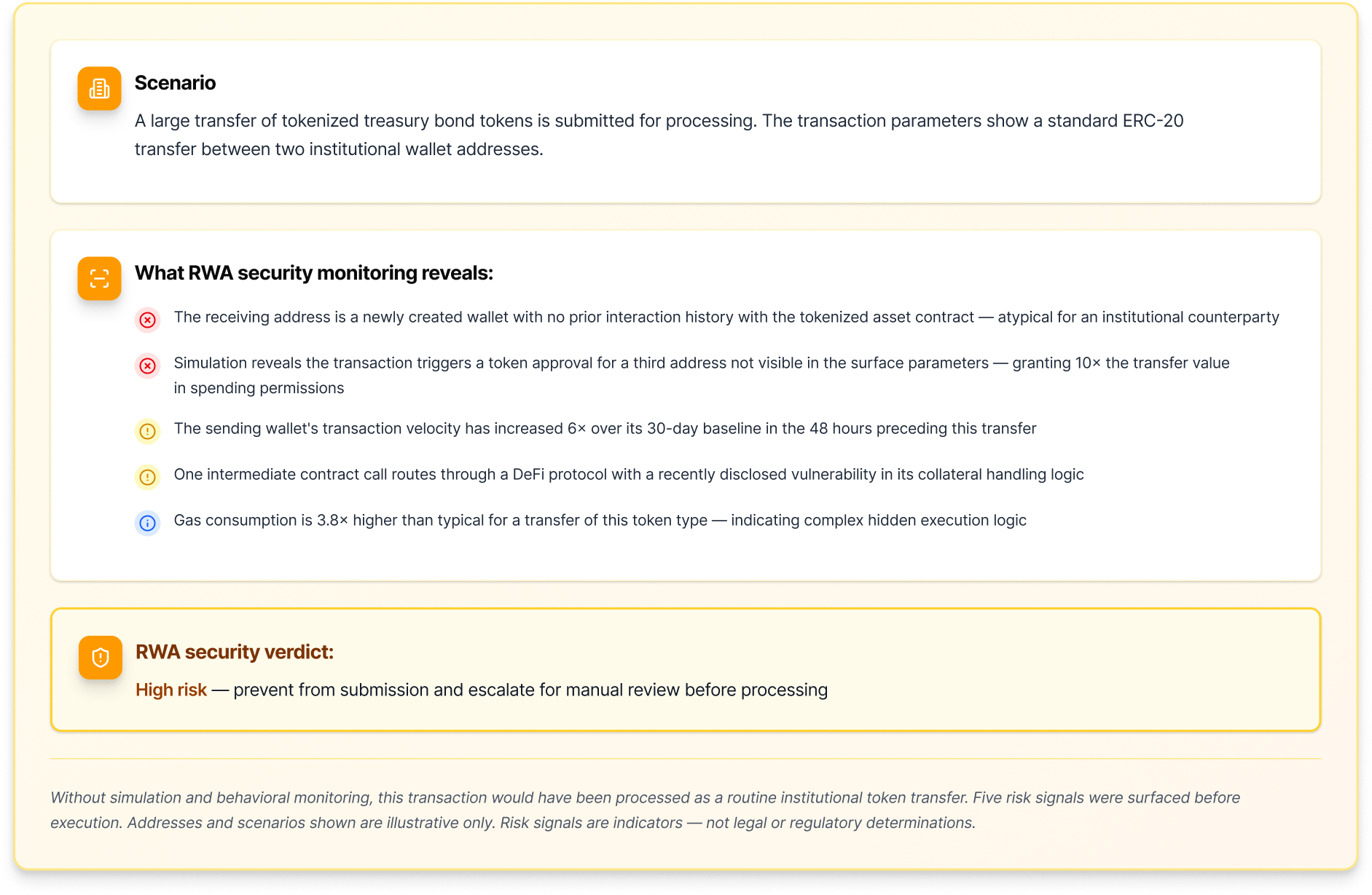
Example: RWA security signals in practice

Here is a concrete example of what RWA security monitoring surfaces for a tokenized asset transaction that appears routine from its parameters alone.
This example illustrates why RWA security cannot rely on transaction parameters alone. The risk is in the execution path — the contract calls, approvals, and state changes that parameters do not reveal. For tokenized assets representing real-world value, the cost of missing these signals is direct and irreversible.

Why Web3Firewall for RWA security

Request a demo
Web3Firewall is a Web3 security and compliance platform — often described as a SIEM for blockchain. It is designed for operational teams who need RWA security controls to run continuously, integrate into transaction workflows, and produce audit-ready records for internal governance, compliance, and review workflows.
The platform combines pre-broadcast transaction simulation, continuous smart contract and wallet monitoring, behavioral anomaly detection, and a programmable policy engine. Transactions routed through Web3Firewall can receive a real-time verdict — allow, deny, or require approval — that applies customer-defined risk and policy rules within configured transaction workflows before a transaction reaches the network. Web3Firewall is designed to support RWA security operations — not to replace the broader governance, legal, and operational controls that tokenized asset infrastructure requires.

Pre-broadcast simulation for tokenized assets

Every transaction routed through Web3Firewall is simulated before broadcast within supported environments — revealing the full execution path including unexpected token approvals, oracle-dependent calls, and cross-protocol interactions invisible from surface parameters. High-value tokenized asset transfers receive a risk verdict before they are confirmed on-chain.

Smart contract interaction monitoring

Continuous monitoring of contract function calls, state changes, and interaction patterns across tokenized asset infrastructure within supported environments. Unusual access control calls, unexpected ownership modifications, and anomalous minting or burning activity are surfaced in real time.

Behavioral monitoring for institutional wallets

Tokenized asset wallets develop behavioral baselines over time. Deviations — unusual transaction volumes, atypical counterparty relationships, sudden activity spikes — are flagged automatically, without relying on known-bad address lists.

Programmable policy engine

Define RWA-specific security and compliance policies in a no-code interface or via API. Policies can be asset-specific, counterparty-specific, transaction-size-specific, or protocol-specific — applying customer-defined risk rules within configured workflows.

Travel Rule and AML/CFT workflow support

For tokenized asset transfers that fall within Travel Rule scope, Web3Firewall supports wallet screening, risk assessment for self-hosted wallet transfers where required under applicable rules and guidance, and audit trail generation for compliance documentation.

Audit-ready records

Every simulation run, monitoring alert, and transaction verdict is logged with execution details, risk signals, and supporting evidence — providing auditable records for internal governance, compliance review, and regulatory examinations.
Disclaimer: Web3Firewall provides risk intelligence and analysis tools. It does not provide legal, regulatory, investment, or securities advice. Risk signals and simulation outputs are indicators designed to support human and automated decision-making within configured workflows — not legal or regulatory determinations.

See RWA security monitoring in action

Try the sandbox to simulate a tokenized asset transaction and see the full execution path, risk signals, and verdict — or book a 30-minute demo to see how Web3Firewall fits into your RWA security operations.

Frequently Asked Questions

What is RWA security?

RWA security refers to the monitoring, smart contract analysis, transaction intelligence, and risk controls used to protect tokenized real-world assets (RWAs) operating on blockchain networks. It covers the full digital layer of tokenized asset infrastructure — including the smart contracts that govern ownership and transfers, the wallets that hold and interact with tokens, and the blockchain transactions that record asset movements.

What is real-world asset tokenization?

Real-world asset tokenization is the process of representing ownership of a traditional asset — such as real estate, government bonds, private credit, or commodities — as a digital token on a blockchain. The token records ownership, enables transfers, and can encode rights such as dividend payments or redemption terms in smart contract logic.

What are the main security risks for tokenized real-world assets?

Key security risks include: smart contract vulnerabilities allowing unauthorised token minting or transfer; wallet compromise affecting token holders or issuers; oracle manipulation affecting valuations used in DeFi integrations; DeFi protocol risks when tokenized assets are used as collateral; cross-chain bridge vulnerabilities; and regulatory compliance risk for transfers subject to AML/CFT or securities law requirements.

How does RWA security differ from traditional asset security?

Traditional asset security relies on custodians, registries, and regulated intermediaries. RWA security must also protect the smart contract and transaction layer that encodes ownership and transfer logic — where code vulnerabilities, wallet risks, and on-chain exploits become a major additional attack surface alongside traditional institutional and operational risks. Blockchain transactions are also irreversible once confirmed, making pre-execution monitoring particularly important.

What is smart contract security in the context of RWAs?

Smart contract security for RWAs involves monitoring the contracts that govern tokenized asset behavior — including ownership records, transfer logic, minting and burning functions, access control, and integrations with external oracles or DeFi protocols. Unusual contract interactions, unexpected state changes, or execution patterns inconsistent with normal asset operations are risk signals that smart contract monitoring surfaces.

What regulations apply to tokenized real-world assets?

The regulatory landscape varies by jurisdiction and asset type. In the EU, tokenized assets qualifying as financial instruments may fall under MiFID II rather than MiCA. Tokenized assets not regulated under existing EU financial-services law may fall under MiCA (Regulation (EU) 2023/1114). The Transfer of Funds Regulation (Regulation (EU) 2023/1113) applies AML/CFT Travel Rule requirements to in-scope transfers. In the US, securities law classification depends on the asset structure, rights conveyed, and the offering and market context. Firms should assess their specific obligations with qualified legal counsel.

How does transaction simulation help with RWA security?

Transaction simulation evaluates how a transaction will execute — including all smart contract interactions, token transfers, and state changes — before it is broadcast. For RWA platforms, this means unexpected token movements, unauthorised contract interactions, and oracle-dependent execution paths can be identified before a transaction is confirmed and becomes irreversible. Pre-broadcast simulation is especially valuable for high-value tokenized asset transfers.

What does Web3Firewall do for RWA security?

Web3Firewall is a Web3 security and compliance platform — often described as a SIEM for blockchain. For RWA platforms, it provides pre-broadcast transaction simulation, continuous smart contract and wallet monitoring, behavioral anomaly detection, and a programmable policy engine that applies customer-defined risk and policy rules within configured transaction workflows. Transactions routed through Web3Firewall can receive a real-time verdict — allow, deny, or require approval — before they reach the network.