

On-chain AML monitoring applies anti-money laundering controls directly to blockchain data — tracking wallet behavior, fund flows, smart contract interactions, and counterparty risk across decentralized networks. This guide explains how it works, what it detects, and why pre-signature monitoring is now a critical layer of modern crypto compliance.
On-chain AML (anti-money laundering) refers to the application of AML controls and monitoring directly to blockchain transaction data — including wallet behavior, fund flows, smart contract interactions, and counterparty relationships across decentralized networks.
Unlike traditional AML systems designed for bank ledgers and closed payment networks, on-chain AML operates on publicly available blockchain data to identify patterns consistent with financial crime, sanctions exposure, or other compliance risk. It uses the public and immutable nature of blockchain data to reconstruct transaction histories, map counterparty relationships, detect behavioral anomalies, and identify patterns consistent with layering, structuring, sanctions-related activity, or other financial crime typologies.
For organizations operating digital asset platforms — cryptocurrency exchanges, custodians, payment providers, and infrastructure operators — on-chain AML monitoring is a practical necessity for meeting AML/CFT obligations. In the EU, obligations are driven by Regulation (EU) 2023/1113 and related supervisory guidance, with MiCA creating separate but operationally adjacent controls. In the US and UK, covered firms may also be subject to obligations under applicable MSB and money-laundering regimes.
On-chain AML monitoring — sometimes called crypto transaction monitoring or blockchain transaction monitoring — works by ingesting publicly available blockchain data and applying multiple analytical layers to identify risk signals. A well-designed system operates across five layers.
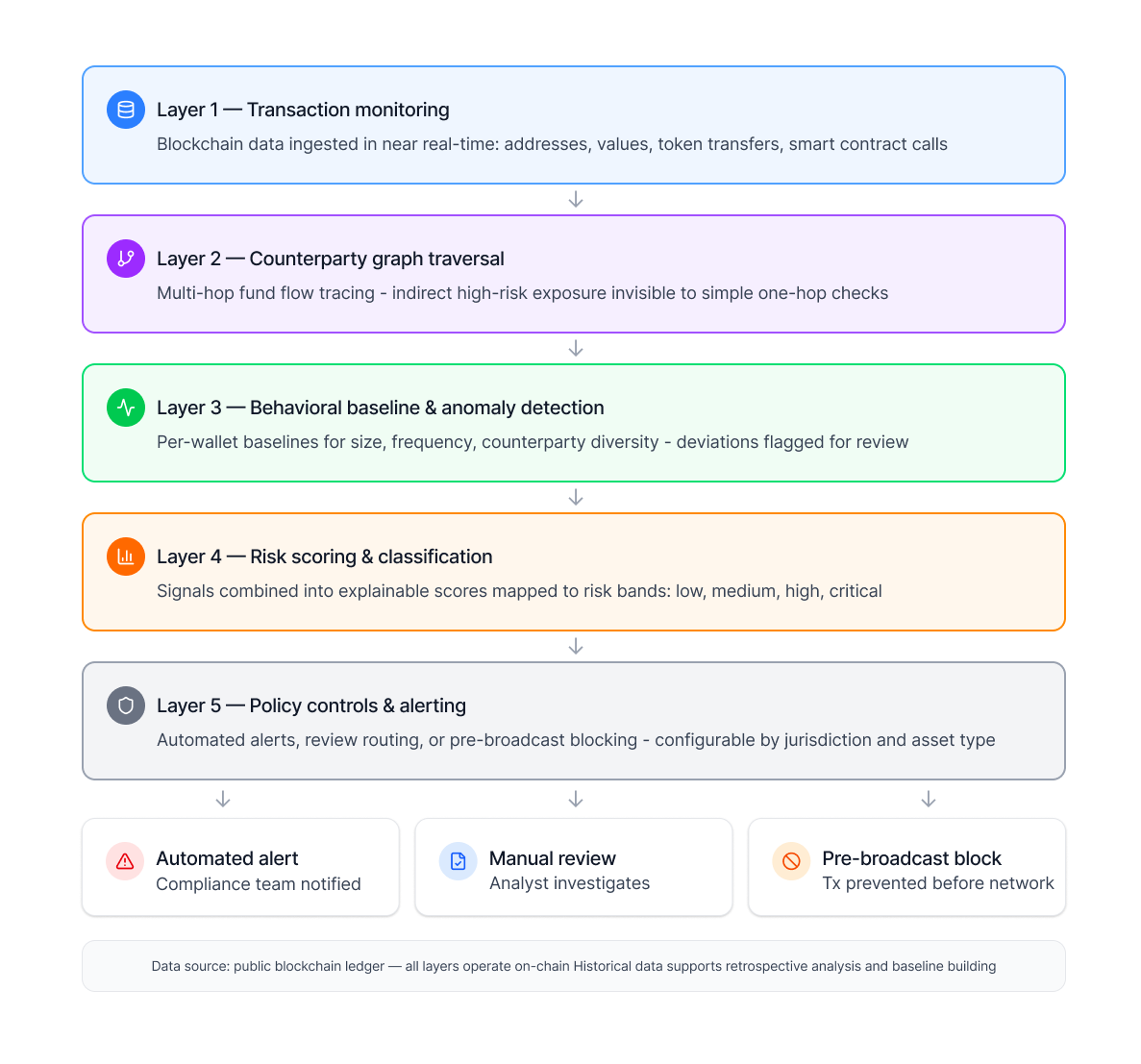
Every transaction confirmed on a monitored blockchain is ingested in near real time — including the sending address, receiving address, transaction value, smart contract calls, and token transfers. Historical data supports retrospective analysis and behavioral baseline building.
On-chain AML goes beyond direct counterparty screening. Graph traversal traces fund flows across multiple hops — identifying indirect exposure to high-risk addresses that would be invisible from a simple one-hop check. A wallet that has never directly interacted with a risky address may still carry elevated exposure if funds passed through one, two, or three hops earlier.
Each monitored wallet develops a behavioral baseline — normal transaction size, frequency, counterparty diversity, and protocol usage. Deviations from this baseline are flagged for review. This layer is critical for detecting novel threats that have not yet appeared on any watchlist.
Individual signals are combined into a structured risk score mapped to risk bands (low, medium, high, critical). Each score is explainable: the signals that contributed, their weights, and the supporting evidence are documented. This explainability supports compliance review and internal documentation workflows.
Risk scores and behavioral signals feed into a policy engine that generates automated alerts, routes transactions for review, or — in pre-broadcast workflows — can prevent a transaction from being submitted before it reaches the network. Policies can be configured by jurisdiction, asset type, counterparty risk tier, or transaction size.
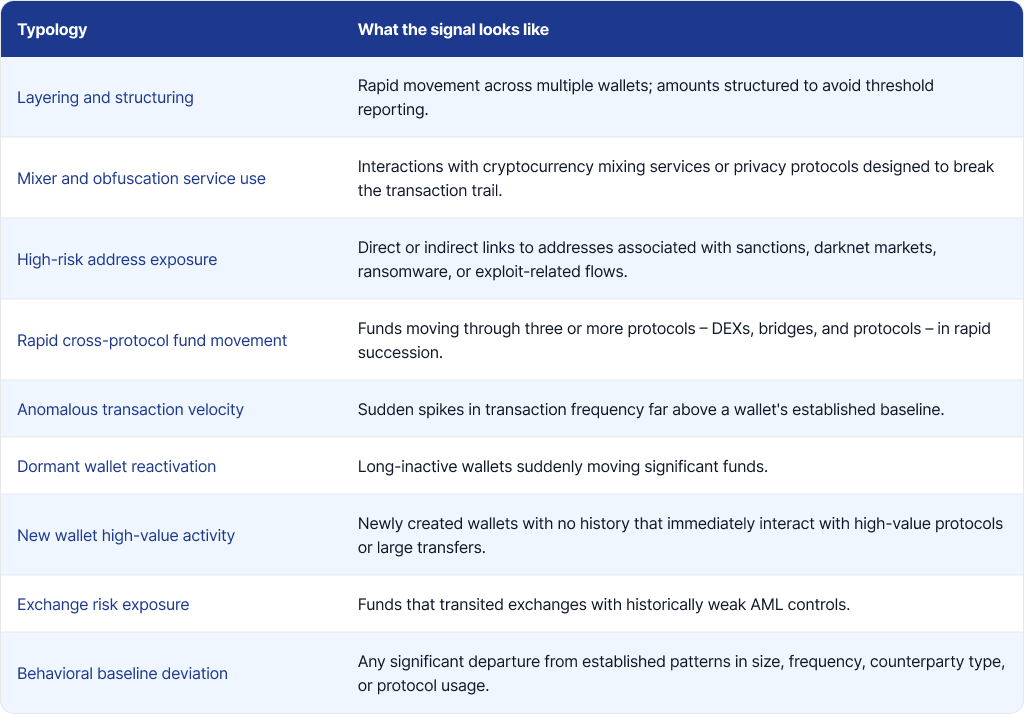
On-chain AML monitoring can identify patterns consistent with a range of financial crime typologies. These signals inform risk assessment — they are indicators, not legal or regulatory determinations.
Traditional blockchain analytics tools are retrospective by design. They ingest confirmed, on-chain transactions and apply graph traversal and risk scoring after the fact. By the time a compliance team receives an alert, the funds have already moved. For high-velocity layering schemes — where illicit funds pass through multiple wallets in minutes — post-confirmation monitoring often means the trail has gone cold before any intervention is possible.
Beyond timing, traditional tools suffer from a visibility gap. They can only see what the blockchain records: wallet addresses, transaction values, token transfers, and smart contract interactions. They have no visibility into who is initiating a transaction, under what circumstances, or what behavioral context surrounds it. Two transactions that look identical on-chain can carry entirely different risk profiles depending on the off-chain context.
Confirmed-transaction-only monitoring is blind to several meaningful risk signals that exist before a transaction is broadcast:
Modern AML frameworks are shifting from detect-and-report to detect-and-prevent. Pre-signature monitoring — evaluating risk signals before a transaction is cryptographically signed and submitted to the network — enables intervention at the only moment it matters: before finality.
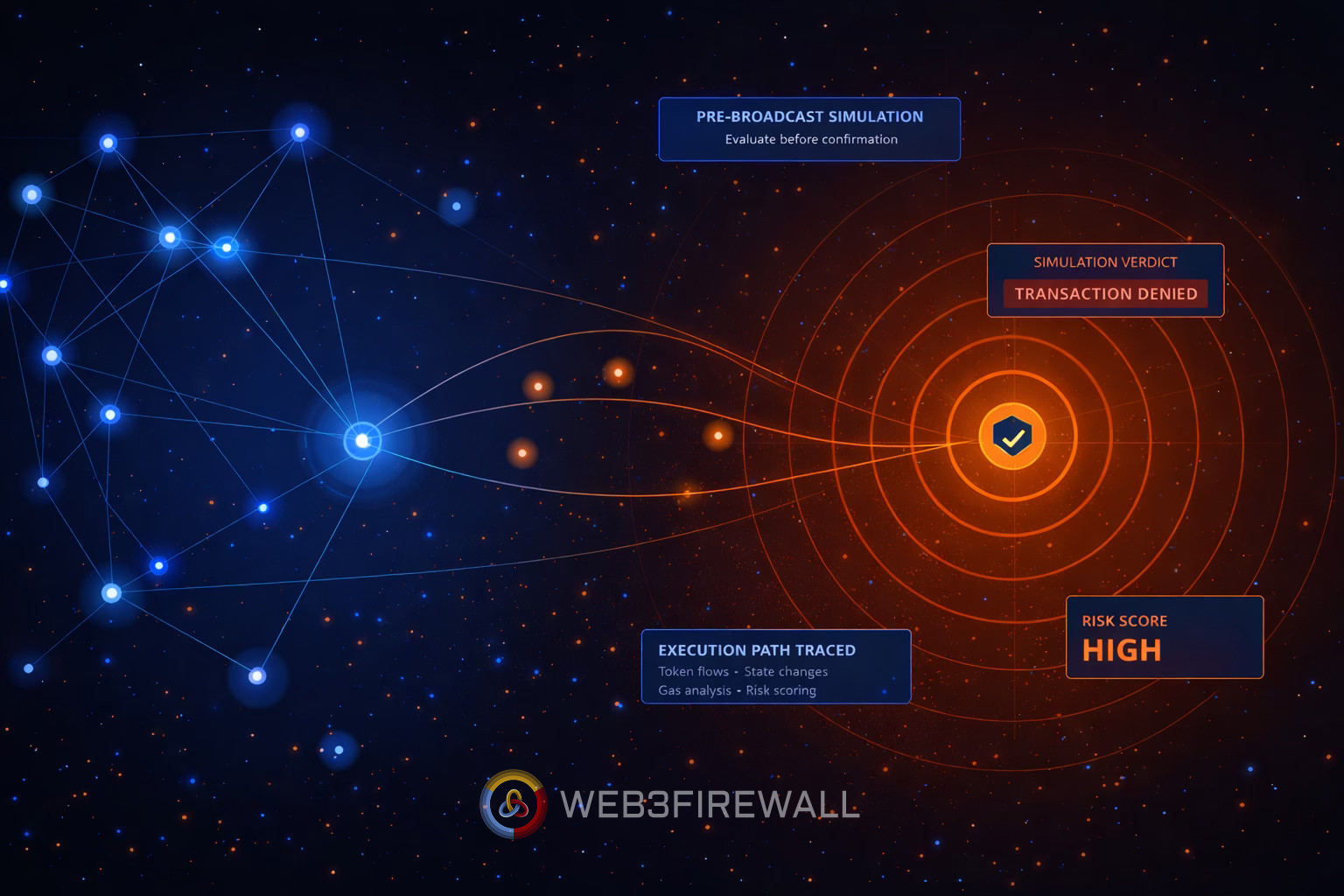
Pre-signature intelligence typically combines wallet-level risk scores, behavioral biometrics from the session initiating the transaction, mempool surveillance, and smart contract simulation — dry-running a transaction to see its full execution path before it goes live. Together, these inputs allow a policy engine to make a hold/approve/escalate decision in milliseconds, before the transaction ever reaches a node.
This is particularly important in institutional and custodial contexts — exchanges, prime brokers, and wallet infrastructure providers — where the platform controls the signing layer and can enforce a pre-broadcast policy without relying on blockchain validators to do so.
Key insight
Instead of identifying a suspicious wallet hours or days after funds have moved and been further layered, a well-instrumented pre-signature layer can flag and freeze a transaction at the moment of intent — collapsing the detection-to-intervention gap from days to milliseconds.
Blockchain analytics is a broad category covering any analysis of on-chain data — including market intelligence, forensic investigation, protocol research, and compliance monitoring. On-chain AML is a specific, operationally-focused application of that toolset.
Blockchain analytics tools are often built for investigators and researchers — powerful for reconstructing transaction histories and building cases after the fact. On-chain AML tools are designed for operational compliance teams — producing structured risk scores, integrating into transaction processing pipelines, generating audit-ready records, and operating at the speed and scale of live transaction volumes.
The Travel Rule is one of the most operationally significant AML obligations for organizations handling crypto-asset transfers. It requires VASPs and CASPs to collect, verify, and transmit originator and beneficiary information alongside every crypto-asset transfer. In the EU, this is governed by Regulation (EU) 2023/1113 and supported by EBA guidance on information requirements and handling of incomplete data. ESMA has published guidelines on transfer services for crypto-assets under MiCA.
For transfers involving self-hosted (unhosted) wallets, CASPs must apply the controls required under Regulation (EU) 2023/1113 and related guidance. On-chain AML tools support due diligence and risk assessment for these transfers — providing structured, auditable risk signals to inform compliance decisions.
Before processing a transfer, CASPs need to assess the risk profile of the counterparty wallet. On-chain AML monitoring supports this assessment by combining direct address screening, graph traversal for indirect exposure, and behavioural analysis — producing a structured risk indicator that can be documented for compliance records.
This content is provided for informational purposes only and does not constitute legal or regulatory advice. Organizations should seek independent legal counsel regarding their specific AML/CFT obligations.