It may be a simple compliance rule, but choosing the wrong solution can cost you. Let’s cover the basics.
What is the Travel Rule?
The Travel Rule requires crypto users to provide accurate information for virtual asset transfers over a certain threshold, follow compliance procedures set by crypto exchanges, and contribute to combating financial crimes in the digital asset space.
Who needs to comply with the Travel Rule
The crypto Travel Rule applies to Virtual Asset Service Providers (VASPs) including:
Crypto exchanges
Custodial wallet providers
Trading platforms
Brokers and OTC desks
Some DeFi gateways (depending on jurisdiction)
Financial institutions that handle virtual asset transfers
It generally does not apply to individualsusing self-hosted (unhosted) wallets, though regulations require VASPs to manage the risks associated with transactions to and from these wallets.
What information must be captured & retained for compliance?
For transactions above a certain threshold (varies by country), VASPs must transmit:
Sender information
Name
Wallet address
Account number or identifier
Physical address
Recipient information
Name
Wallet address
Account number or identifier
Physical address
Additionally, identifiers like date of birth, national ID, or customer ID are required for verification.
What is the threshold amount to trigger the Travel Rule
FATF Recommendation: While often adopted, the global standard suggests a $1,000 USD/EUR threshold for virtual assets, though many countries set different limits. Here’s a quick sampling of the threshold limits for some key countries:
United States: $3,000 for both fiat and cryptocurrency transfers (FinCEN.gov)
European Union (EU): No minimum threshold for transfers between VASPs and non-obliged entities, requiring data for all crypto transactions under Dotfile
United Kingdom: Requires information for transactions of 1,000 EUR or more (or equivalent)
Singapore: SGD 1,500 threshold for digital payment token transfers
Japan: Applies to all transactions with no minimum threshold
South Korea: International transfers over KRW 1 million (approx. $700-$800 USD) are subject to strict reporting
How do VASPS practically comply with the Travel Rule?
VASPs comply with the Travel Rule by implementing technology solutions that collect, secure, and transmit required originator/beneficiary data to the recipient VASP before or during transactions. Some of the popular solutions used today include Chainalysis, 21 Analytics, SumSub, Notabene and, of course, Web3Firewall.
What are the key considerations for choosing a Travel Rule technology partner?
Every technology provider offers different levels of compliance functionality. So here’s some of the key questions to ask when comparing different solutions in this space.
Can the technology provider support different threshold amounts based on the jurisdiction? If you’re only operating in one jurisdiction, then this is a non-issue, but if you’re operating across different jurisdictions, you’ll need to implement multiple policies based on where the transaction originated. Unfortunately, most technology providers in this space cannot support this level of complexity.
Can the technology provider support multiple sanction (AML) screening protocols? If you’re operating across multiple theaters, you’ll also be required to apply the right type of Anti-Money Laundering screening check. If the transaction occurs in the US, you’ll need to ping OFAC; in the UK, you’ll ping the UK Sanctions List. Remember, to satisfy the Travel Rule, you must show regulators that you have applied the correct sanctions screening before you processed the transaction. If either originator or beneficiary are on a sanctions list, the transaction must be rejected regardless of the amount.
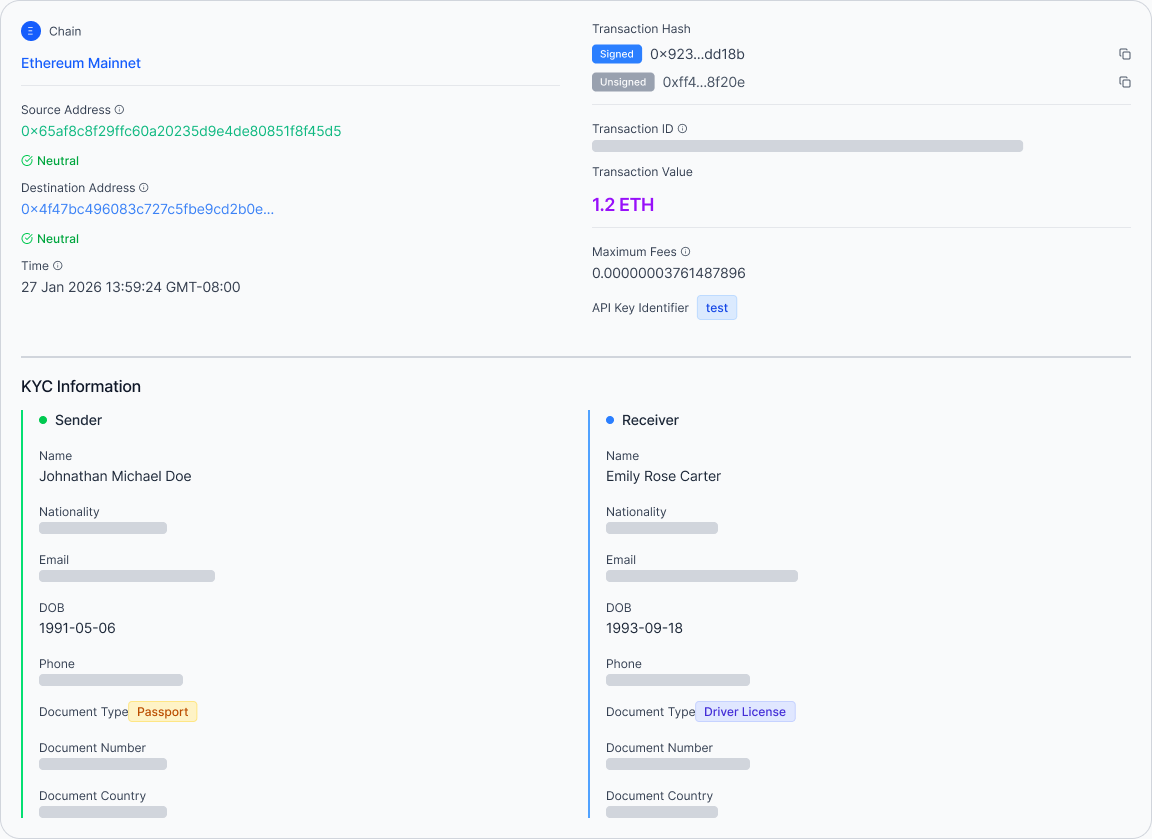
Can the technology provider include all the relevant transaction details to satisfy the Travel Rule? Remember, if the transaction amount is over the threshold amount the VASP is required to capture all the requisite details of the sender (originator) and receiver (beneficiary) as well as additional KYC information such as date of birth, national ID, or customer ID. In many cases, the technology vendor may only provide a small subset of this data, and you’ll be required to use another technology provider (e.g., Sardine) to ingest the KYC data. In practical terms, this means that you’ll need to leverage your own IT team to bring together disparate data sets from different data sources into an intelligible, consolidated dashboard. Ideally, you could use a single vendor to furnish the complete profile of originator and beneficiary?
Source: Web3Firewall
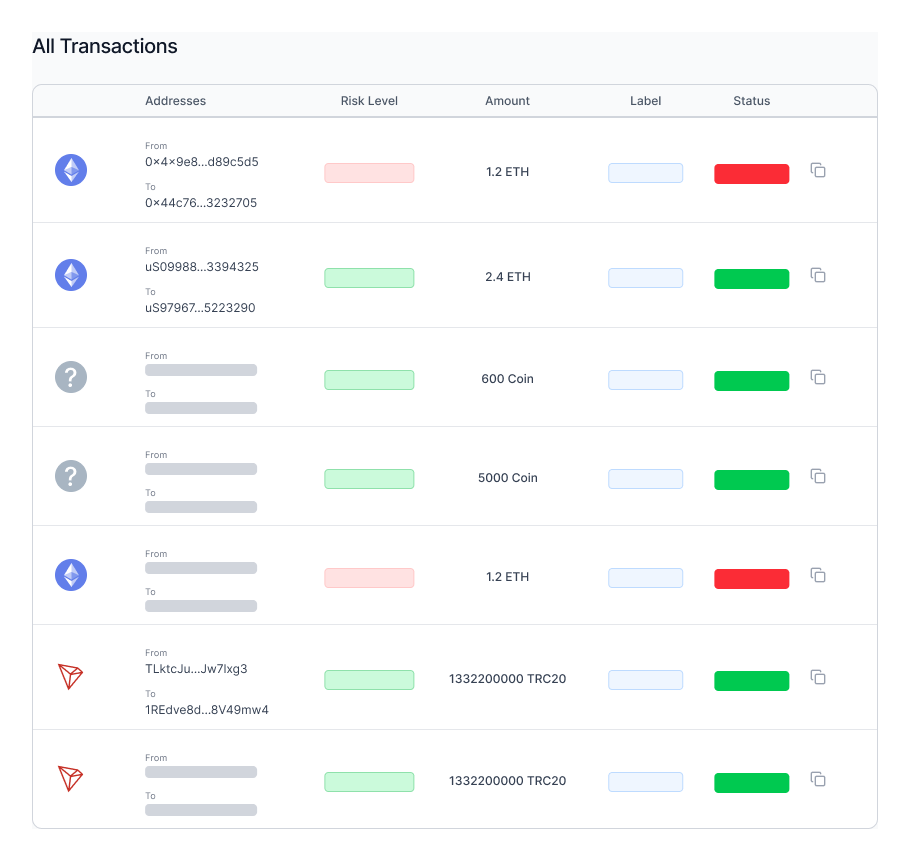
How easy is it to demonstrate that you’ve complied with the Travel Rule? When the regulator drops in and performs a Travel Rule audit, they’re going to ask to see all the transactions for a specific date range and ask you to demonstrate how you’ve complied with the rule and captured all the necessary information. Practically speaking, you first need to demonstrate how you applied the correct AML screening protocols (e.g., OFAC) to all transactions. Secondly, you’ll need to show them how you’ve captured all the requisite originator/beneficiary info for all eligible transactions above the threshold amount. This should be a trivial request, but, in reality, most technology providers cannot publish a simple report that meets these requirements. All too often, it usually takes many man hours to pull this all together.
Source: Web3Firewall transaction report filtered by policy.
What’s the value of having a complete Travel Rule solution?
As you might have guessed from the above questions, choosing a Travel Rule technology partner is not just a tick box exercise. Yes, you must be compliant, but you need to be efficient too.
If you have to integrate multiple point solutions, one to capture basic transaction details and another for KYC customer details, that’s not efficient.
If you cannot apply different AML screening rules based on the jurisdiction, that’s not practical.
If you cannot quickly produce an auditor report, with the click of a button, that’s not a good use of your analysts’ time and efforts.
You probably know where this is going.
At Web3Firewall, we provide you with the controls to meet and easily comply with the mandates of the Travel Rule. This includes the ability to apply different policies based on each jurisdiction, the ability to ingest KYC information into a single, consolidated dashboard, and the ability to produce compliance reports with just a couple of mouse clicks.
Trust me. A little extra due diligence upfront during vendor selection will save you a lot of downstream headaches.