

Virtually every crypto business, exchange, and financial institution is relying on some flavor of third-party wallet screening to maintain regulatory compliance and prevent financial crime.
Digital wallet screening is the process of analyzing cryptocurrency wallet addresses to assess risk levels, verify ownership, and identify connections to illicit activities like money laundering or sanctions evasion. It serves as a crucial AML (Anti-Money Laundering) compliance layer, scanning blockchain transactions against watchlists to detect high-risk behavior and ensure regulatory adherence.
The Manual Problem
Digital wallet screening times vary significantly based on whether the process is for setting up identification (like a driver's license) or for verifying transactions (such as cryptocurrency). Generally, automated, straightforward screenings take anywhere from a few minutes to two hours. However, the process can take days due to manual review of flagged accounts, anti-money laundering (AML) regulations, and sanctions checks. When automated systems detect high-risk patterns — such as unusual transaction volumes or new, high-value transfers — the account is placed on hold for human investigation. Additional delays arise from blockchain congestion or required Know Your Customer (KYC) document verification.
Why Traditional Wallet Screening Fails
Legacy wallet screening tools often rely on static lists, manual reviews, and post-incident labeling. Often, operators need to perform crypto taint tracing,which tries to flag funds from illicit sources (mixers, sanctioned wallets) using advanced analytics to assess risk. We touched on some of this complexity in an earlier blog post, titled The Evolution of Wallet Screening.
Why Speed Matters
With legacy wallet screening, delayed results translate into lost opportunity. Attackers move on, funds get laundered, and operators are forced to become reactive since the transactions have already settled on the blockchain. Delayed risk assessments result — often caused by high false-positive rates, manual review bottlenecks, or inefficient legacy systems — result in severe repercussions, including regulatory penalties, significant financial losses due to fraud, and high customer attrition. In a landscape demanding instant payments, these delays create "visibility gaps" that allow tainted funds to move through systems, leading to retroactive liability for financial institutions.
What does Proactive Screening Look Like?
The good news is that wallet screening is getting simpler, faster and stronger. With legacy wallet screening services, their primary focus is to evaluate the overall reputation of a digital wallet. They do this by analyzing the settled transactions of that wallet over time and assigning a risk score. Unfortunately, by the time it takes for a wallet to be tarnished with a bad reputation, the bad actor may have already created 10 new wallets that aren’t tainted with a poor reputation score.
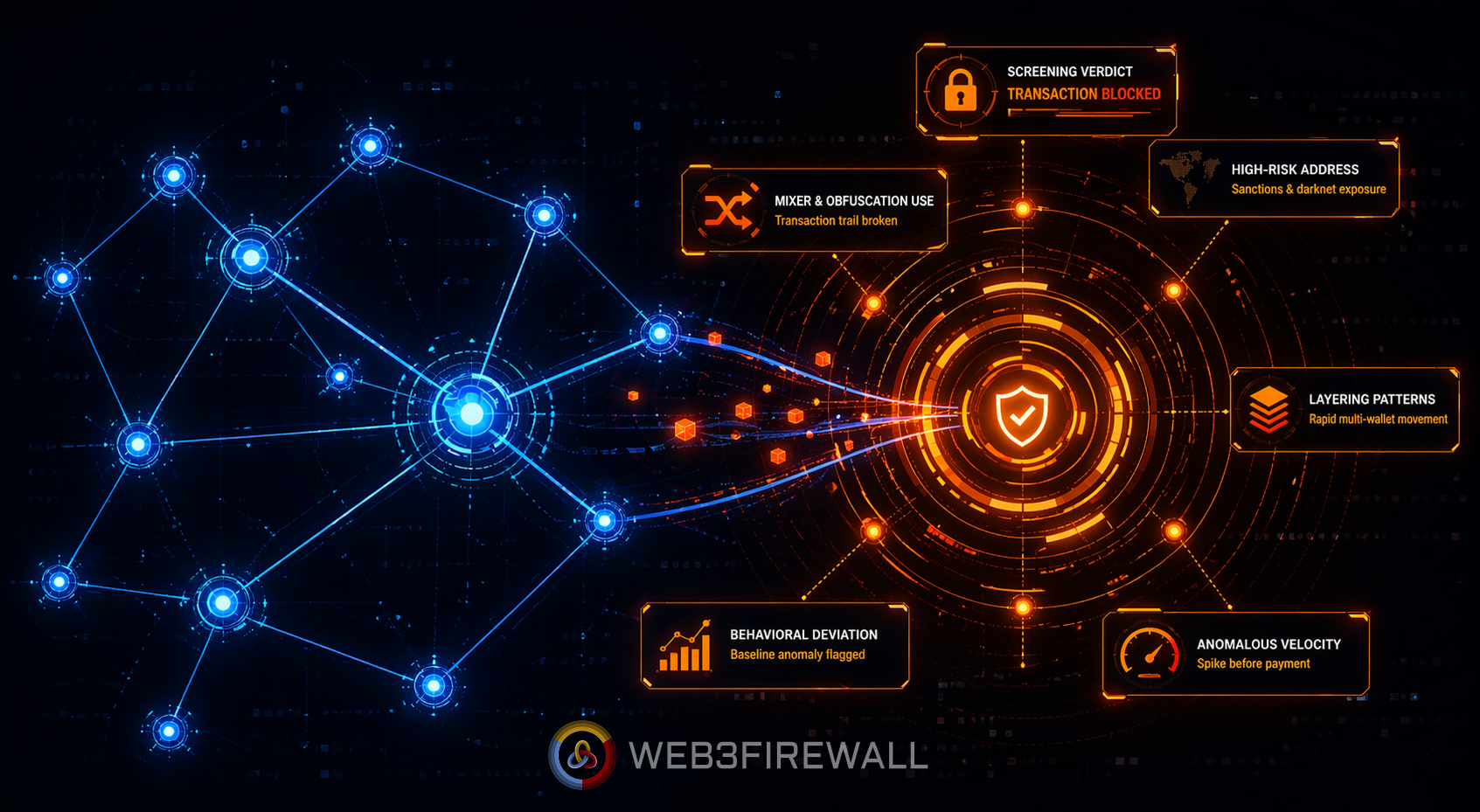
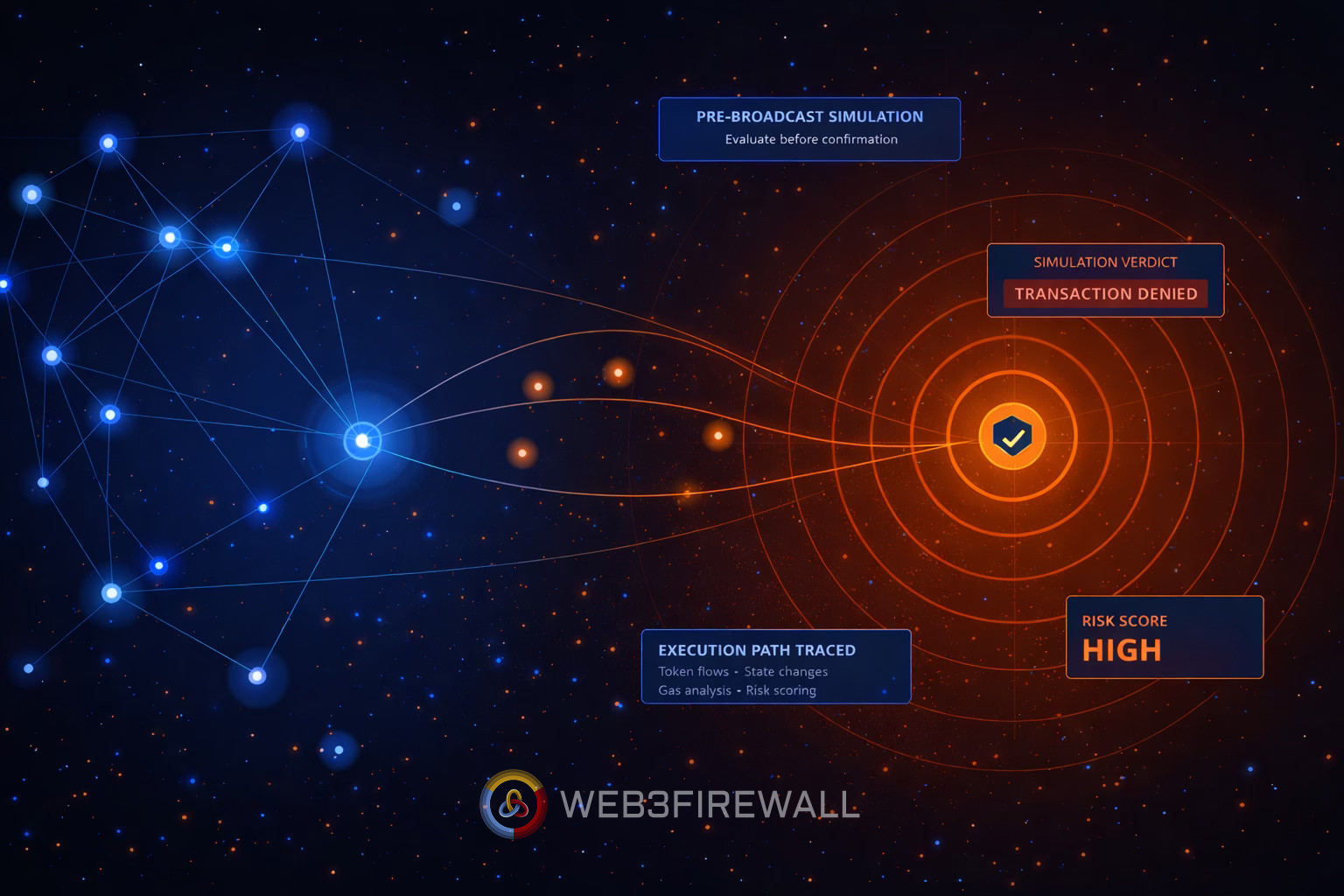
Modern wallet screening solutions, like Web3Firewall, analyze blockchain transactions in real-time and assess the risk of that transaction based on a myriad of pre-signature signals. Let’s start with the inputs and the types of outputs being used by modern wallet screening solutions to better assess transactional and reputational risk.
The Inputs
The Outputs
Now let’s explore and define each of these outputs:
Confidence-Weighted Risk Score: Risk scoring is the process of evaluating the safety, compliance, and illicit activity exposure of crypto wallet addresses. These scores assess risk by analyzing on-chain behavior, sanction list matches (OFAC), involvement in hacks or scams, and connections to mixers. Increasingly, AI is being leveraged to create these scores based on machine-learning risk models trained on large-scale on-chain data while generative AI is being used for contextual interpretation and edge-case reasoning. As a result, these risk scores are becoming more explainable, auditable, and fast.
Multi-Source Reputation Attributes: This involves running a variety of pre-signature wallet inspections, including test transactions, contract interaction scanning, and repeated low-value behavioral signals which provide real-time risk assessments of digital wallets.
Burner Wallet Discovery: A burner wallet is a temporary, single-use crypto account created for interacting with risky dApps, NFTs, or maintaining privacy. Because they are temporary, they often lack long-term on-chain history, making them harder to attribute to a permanent identity. Attackers rotate wallets to evade detection. Burner wallet discovery looks at short-lived wallet lifecycles, coordinated funding and drain behavior, and reused infrastructure and orchestration patterns. We’re getting into the weeds here, but this is precisely why digital wallet screening is evolving so quickly.
Reconnaissance Detection: Reconnaissance detection involves using blockchain analytics and real-time monitoring tools to identify, evaluate, and flag high-risk cryptocurrency addresses before transactions occur. It protects platforms by screening against sanctions lists, analyzing behavior for anomalies (e.g., mixers, high-frequency moves), and detecting, analyzing, and preventing illicit or fraudulent activity. This allows early detection before exploitation or laundering begins.
12-hop Exposure Intelligence: Transaction hop analysis is an essential component of modern anti-money laundering and sanctions compliance, particularly as illicit actors increasingly use complex, multi-hop, and cross-chain transactions to obfuscate the origin of funds. Leading wallet screening services analyze six hops backward and six hops forward to uncover: indirect exposure paths, laundering routes and hidden counterparty risk.
Temporal & Spatial Risk Analysis: Temporal risk analysis involves examining blockchain addresses against sanction lists and behavioral patterns over time to identify illicit activity, such as mixers or rapid transfers, enabling real-time, proactive risk mitigation and compliance. Spatial risk analysis examines how wallets behave in relation to others revealing coordinated activity and hidden relationships.
Temporal Risk Analysis (over time)
Spacial Risk Analysis (between wallets)
Zero-History Wallet Protection: Digital wallets with "zero history" (e.g., a new wallet) can be used by bad actors for theft and scams. Sadly, most wallet screening services cannot detect these potentially dangerous wallet types. Scammers use zero history wallets to hide the origin of funds, evade tracking by authorities, and deceive victims in schemes like address poisoning and investment fraud. The lack of history provides an illusion of legitimacy or makes tracing funds difficult. Modern wallet screening providers sniff out zero-history wallets, block the transaction, and alerts your team prior to any damage being inflicted.
Exposure & Pollution Measurement:There are a number of metrics that leading wallet screening solutions are starting to leverage to better understand a digital wallet’s interaction with high risk entities including time-weighted exposure, amount-weighted exposure and pollution decay. Let’s briefly look at each one:
Wallet Screening, Done Right
Legacy wallet screening solutions evaluate wallets after transactions have posted and return a risk category (low, medium, high, and severe). Oftentimes, the wallet screening service places the burden of research on the crypto operator rather than providing real insights and a complete risk assessment. This type of forensic analysis definitely has its place, but it is often slow especially when manual review is required – and this places a heavy tax on your operations. Plus, whenever there is a human element involved in the review process, you’re introducing bias and inconsistency as different reviewers may produce different risk assessments.
Modern wallet screening (e.g., Web3Firewall) is more automated and secure because risk assessments occur before exposure (i.e., pre-signature) thanks to built-in controls to flag high-risk transactions. Instead of looking at a handful of risk signals after-the-fact, modern wallet screening solutions are evaluating a large number of signals in real-time to better assess the risk of every transaction as well as the overall reputation of the wallet. This helps keep you one-step ahead of increasingly sophisticated and AI-fueled fraudsters.