Web3Firewall: The Leading Risk and Compliance Solution for XDC Network

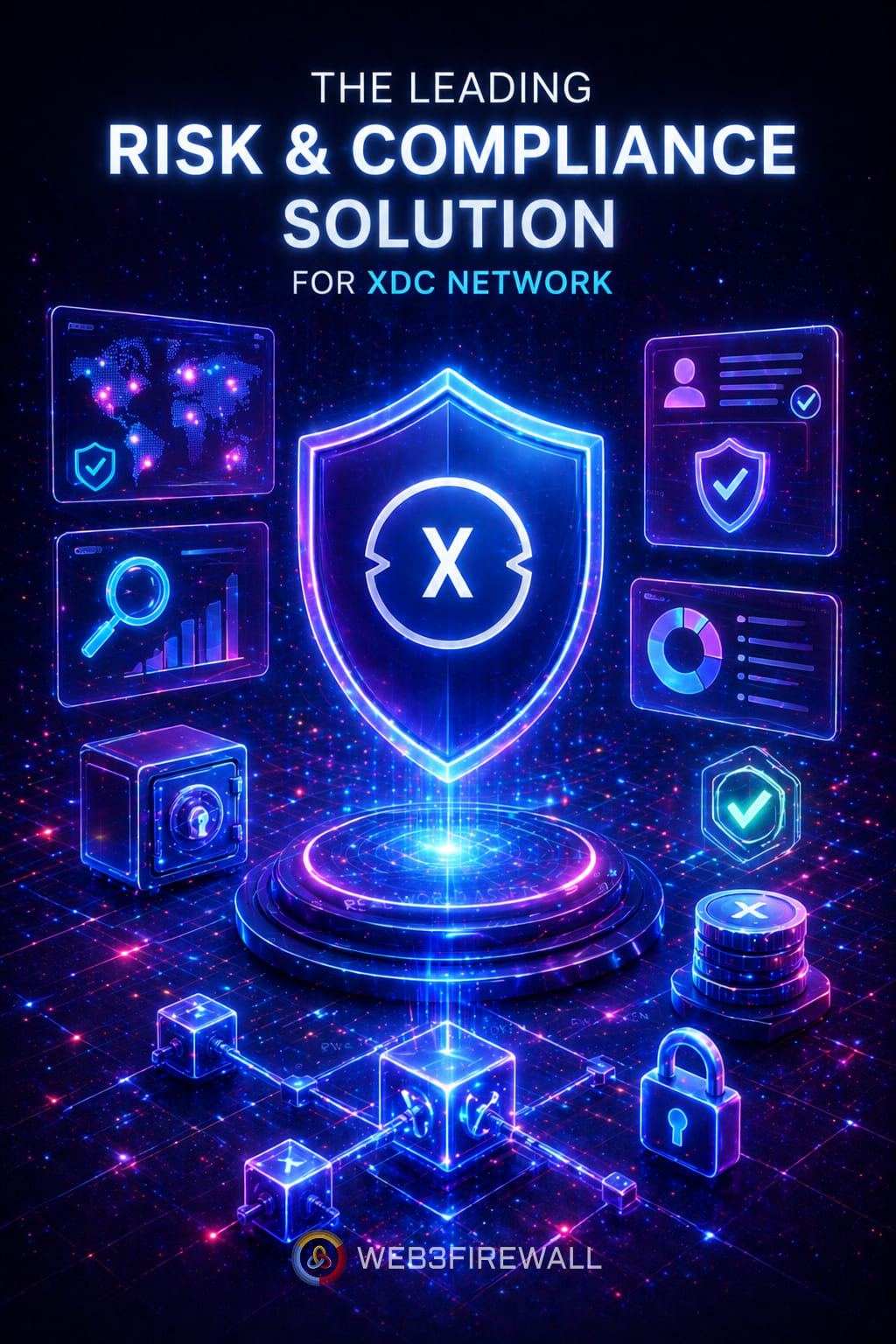
Institutional adoption of XDC Network is accelerating across trade finance, cross-border payments, and real-world asset tokenization. With that growth comes increased exposure to financial crime, AML risk, counterparty fraud, and regulatory scrutiny. Web3Firewall is purpose-built to address these challenges — delivering real-time transaction monitoring, pre-execution risk simulation, and compliance enforcement for enterprises, financial institutions, and regulated entities operating on XDC.
Real-time — Every XDC transaction evaluated before settlement
Pre-execution — Fraud and policy violations detected before broadcast, not after confirmation
Enterprise-grade — Built for banks, payment providers, trade finance platforms, and compliance teams
Book a Demo

Why XDC Network Needs Advanced Risk and Compliance Solutions

The XDC Network is rapidly establishing itself as the leading blockchain infrastructure for institutional financial applications. Its combination of high throughput, low transaction costs, EVM compatibility, and ISO 20022 alignment has made it the network of choice for trade finance, cross-border payments, and real-world asset tokenization at institutional scale.
That institutional adoption brings institutional risk exposure.
Financial crime and fraud risk
High-value transaction flows attract sophisticated fraud operators. Trade finance instruments, payment rails, and tokenized assets are all potential targets for manipulation, misrepresentation, and fraudulent activity.
AML and regulatory exposure
Organizations operating on XDC face the same AML obligations as any financial institution processing equivalent transaction volumes. Sanctions screening, counterparty risk assessment, and suspicious activity reporting are requirements — not optional controls.
Counterparty risk
XDC's role in connecting financial institutions, trade finance platforms, and payment providers creates counterparty relationship complexity. Understanding the risk profile of every address and entity in a transaction chain is operationally critical.
Transaction anomalies
Abnormal value transfers, unusual transaction patterns, and behavioral deviations from established baselines are signals that precede fraud events. Detecting them requires analysis that operates at transaction speed, not in batch review cycles.
Regulatory scrutiny
As blockchain-based financial infrastructure scales, regulatory expectations are moving toward requiring demonstrable compliance effectiveness — not just policy documentation. Organizations on XDC need compliance infrastructure that produces verifiable outcomes.
A dedicated risk and compliance intelligence layer is not optional for institutional XDC operations. It is the infrastructure that makes regulated-scale adoption viable.

Web3Firewall — Built for XDC Risk Management and Compliance

Web3Firewall is an AI-powered blockchain security and compliance platform that delivers real-time protection for XDC-based transactions, wallets, and smart contract activity. It operates as a pre-execution enforcement layer — evaluating every transaction before it reaches the network, not after it confirms.
What makes Web3Firewall purpose-built for XDC? XDC's use cases — trade finance settlement, cross-border payment rails, RWA tokenization — require compliance infrastructure that understands institutional transaction patterns, can evaluate complex multi-party transaction chains, and operates at the throughput XDC is designed for. Web3Firewall's EVM-compatible architecture, enterprise policy engine, and proprietary behavioral intelligence are aligned with exactly these requirements.

Key Capabilities for XDC Risk and Compliance

Request a demo

Real-time transaction risk monitoring on XDC

Web3Firewall analyzes every transaction on XDC in real time — detecting suspicious transaction patterns, abnormal value transfers, high-risk counterparties, and fraudulent behavior before settlement. Organizations using XDC for trade finance and payment settlement cannot afford to identify fraud after funds have moved. Real-time monitoring at the transaction layer provides the intervention window that post-settlement analysis cannot.

AML and compliance monitoring for XDC wallets

Web3Firewall provides comprehensive AML monitoring infrastructure for XDC wallet activity: wallet risk scoring and address intelligence profiling, AML monitoring and reporting aligned with regulatory requirements, and sanctions and high-risk entity detection across every counterparty interaction. Organizations meet KYC and AML requirements on XDC without adding manual compliance overhead that slows institutional workflows.

Pre-transaction simulation and risk prevention

Unlike traditional compliance tools that review settled transactions, Web3Firewall evaluates XDC transactions before they are executed. Transactions are simulated prior to broadcast — detecting anomalies based on historical behavioral patterns, flagging policy violations before they become confirmed events, and preventing fraud and exploits before funds move. For institutions where transaction irreversibility creates direct financial exposure, pre-execution evaluation is the only architecture that meets the risk standard.

Behavioral analytics and anomaly detection

Web3Firewall uses advanced AI models to establish behavioral baselines for XDC wallets and flag deviations as they occur. Normal behavior patterns for wallets, protocols, and counterparty relationships are learned continuously. Deviations — unusual transaction sequences, atypical value flows, early-stage reconnaissance activity — are surfaced as risk signals before they escalate. This is the foundation of fraud prevention and advanced threat detection on XDC that static rule-based tools cannot provide.

Policy engine for compliance enforcement

Web3Firewall's programmable policy engine allows institutions to define and enforce custom compliance rules for XDC activity: automatically blocking high-risk transactions, requiring manual approval for suspicious activity, enforcing internal risk policies across all accounts and workflows, and calibrating enforcement to specific risk thresholds and transaction categories. Financial institutions and enterprise-grade operations running on XDC require compliance infrastructure that enforces rules consistently — not compliance that depends on individual analyst judgment at scale.

Risk intelligence for real-world asset tokenization on XDC

As XDC leads in RWA tokenization — tokenized trade finance instruments, real estate assets, commodities, and financial products — Web3Firewall provides the risk intelligence layer this asset class requires: risk scoring for tokenized assets and their associated contracts, continuous monitoring of asset transfer activity for anomalous patterns, and counterparty risk analysis for every party involved in tokenized asset transactions. Secure and compliant handling of real-world financial instruments on XDC requires risk infrastructure that understands both the on-chain mechanics and the off-chain financial reality of each asset.

Why Web3Firewall Is the Right Compliance Solution for XDC

Purpose-built for institutional use
Web3Firewall is designed for the organizations that XDC is designed for — banks and financial institutions, payment providers, trade finance platforms, and compliance and risk teams. The product architecture, policy engine, and audit infrastructure reflect institutional requirements, not retail use cases adapted for enterprise.
Scalable for high-volume XDC transactions
XDC's architecture delivers low fees and high throughput at institutional scale. Web3Firewall's risk analysis operates at the same speed — real-time monitoring and high-performance risk analysis that scales with XDC transaction volume without creating compliance bottlenecks.
EVM-compatible integration
XDC's EVM compatibility means Web3Firewall integrates seamlessly with existing Ethereum-based infrastructure, smart contracts, dApps, and Web3 security workflows. Organizations already operating on EVM-compatible infrastructure can deploy Web3Firewall for XDC without rebuilding existing security and compliance tooling.
AI-powered proprietary risk intelligence
Web3Firewall uses self-generated, proprietary threat intelligence — not third-party feeds with inherent latency and coverage gaps. Emerging fraud patterns, sophisticated attack behaviors, and unknown threats in XDC ecosystems are detectable through behavioral analysis that does not depend on prior signature matching.

Use Cases: Risk and Compliance on XDC

Request a demo

Trade finance security

XDC's role in trade finance — invoice financing, settlement, letter of credit processing, and supply chain finance — involves high-value transaction flows between multiple institutional counterparties. Web3Firewall prevents fraud in trade finance instruments and settlement flows, monitoring for manipulation, duplicate financing, and counterparty risk signals across every transaction.

Cross-border payments compliance

XDC's cross-border payment infrastructure connects financial institutions across jurisdictions with different AML requirements and sanctions regimes. Web3Firewall monitors AML risks in global transfers, screens counterparties against sanctions lists, and provides the compliance documentation that cross-border payment flows require.

RWA tokenization risk management

Real-world asset tokenization on XDC creates new risk categories — asset backing verification, transfer restriction compliance, counterparty eligibility, and secondary market monitoring. Web3Firewall secures tokenized assets and their transactions, providing the risk intelligence layer that institutional RWA operations require.

Exchange and on-ramp compliance

Exchanges and fiat on-ramps operating on XDC face AML, KYC, and sanctions obligations across high volumes of user transactions. Web3Firewall provides the automated compliance monitoring and risk scoring that enables compliant operation at exchange scale without proportional increases in manual review headcount.

DeFi protocol protection

DeFi protocols built on XDC face exploit, fraud, and anomalous activity risk that smart contract audits do not fully address. Web3Firewall detects exploits and abnormal activity before execution, protecting protocol TVL and user funds.
Future-Proofing XDC Operations

As regulation tightens around institutional blockchain adoption and XDC's role in regulated financial infrastructure expands, having dedicated XDC risk and compliance infrastructure is moving from competitive advantage to operational requirement.
The trajectory is clear: regulators are moving toward effectiveness-based compliance standards — requiring demonstrable detection and prevention of financial crime, not just documented procedures. XDC organizations that build real-time risk intelligence infrastructure now will be ahead of regulatory requirements as they formalize.
Web3Firewall enables organizations operating on XDC to reduce fraud and financial risk through pre-execution detection, maintain regulatory compliance through automated AML monitoring and audit-ready records, gain real-time visibility into all XDC activity across wallets and protocols, and secure high-value transactions at scale without the operational overhead of manual compliance review.

XDC Operations at Institutional Scale Require Institutional-Grade Compliance

Web3Firewall provides the risk monitoring, AML compliance, and pre-execution enforcement infrastructure that XDC's institutional use cases demand.

Frequently Asked Questions

What is XDC Network and why does it need risk and compliance tools?

XDC Network is an enterprise-grade blockchain designed for trade finance, cross-border payments, and real-world asset tokenization. Its institutional use cases — high-value financial instruments, regulated payment rails, tokenized assets — require the same AML monitoring, fraud prevention, and compliance infrastructure that equivalent traditional finance operations require. The difference is that XDC transactions are irreversible and settle in seconds, making pre-execution risk detection essential rather than optional.

How does Web3Firewall monitor AML risks on XDC?

Web3Firewall provides continuous AML monitoring for XDC wallet activity — wallet risk scoring, address intelligence profiling, counterparty screening against sanctions lists and high-risk entity databases, and behavioral anomaly detection that surfaces suspicious activity patterns before they result in confirmed compliance events. Monitoring operates in real time, not in batch review cycles.

What is pre-transaction simulation for XDC?

Pre-transaction simulation evaluates an XDC transaction's full execution outcome — value transfers, counterparty interactions, contract calls, and behavioral consistency — before it is broadcast to the network. This allows fraud, policy violations, and anomalous patterns to be detected and blocked before the transaction confirms and becomes irreversible. For institutions where settled transactions cannot be reversed, pre-execution simulation is the only architecture that prevents loss rather than just detecting it.

How does Web3Firewall integrate with XDC infrastructure?

XDC's EVM compatibility allows Web3Firewall to integrate with existing Ethereum-based infrastructure, smart contracts, and Web3 security workflows without rebuilding existing tooling. Web3Firewall operates as an API-first external layer — connecting to XDC transaction flows before broadcast, evaluating risk and policy compliance, and returning enforcement decisions in real time.

Who needs XDC risk and compliance solutions?

Any organization operating on XDC at institutional scale — banks and financial institutions, payment providers, trade finance platforms, exchanges and on-ramps, DeFi protocols, and compliance and risk teams overseeing XDC-based operations. XDC's institutional use cases create institutional-grade compliance obligations. Web3Firewall provides the infrastructure to meet them.

How does Web3Firewall support RWA tokenization compliance on XDC?

Web3Firewall provides risk scoring for tokenized assets and their associated smart contracts, continuous monitoring of tokenized asset transfer activity for anomalous patterns, and counterparty risk analysis for every party involved in RWA transactions. As XDC becomes the infrastructure for tokenized trade finance instruments, real estate, and financial products, the risk intelligence layer for those assets becomes as important as the smart contract infrastructure that represents them.