Crypto Supply Chain Attacks: How Web3 Infrastructure Gets Compromised Before a Single Transaction Fires

In a supply chain attack, the threat doesn't come from a vulnerable smart contract or a phishing link. It comes from the infrastructure your protocol, wallet, or dApp depends on — the npm package, the frontend, the RPC endpoint. By the time a transaction reaches the blockchain, the damage is already baked in. This guide explains how crypto supply chain attacks work, why they are the hardest category to detect, and how behavioral verification stops them regardless of where the compromise originated.

A crypto supply chain attack occurs when attackers compromise trusted dependencies, infrastructure, or third-party services to inject malicious code into Web3 applications.
Book a Demo

What Is a Crypto Supply Chain Attack?

A crypto supply chain attack is a category of exploit that compromises the tools, libraries, infrastructure, or interfaces that a protocol or wallet depends on — rather than attacking the smart contract code directly.
What is a Web3 supply chain attack?A Web3 supply chain attack occurs when a malicious actor infiltrates a dependency in the software stack that on-chain protocols rely on — such as an npm package, a JavaScript library, a frontend CDN, or an RPC provider. The attack is delivered through trusted infrastructure, making it exceptionally difficult to detect through conventional means.
What makes supply chain attacks different from other crypto exploits?Most crypto security focuses on the contracts — auditing code, verifying logic, screening addresses. Supply chain attacks bypass all of that. The contracts are fine. The audit is clean. The compromise lives upstream, in the infrastructure the contracts depend on.
Why are supply chain attacks the most dangerous category in Web3?Supply chain attacks are invisible at the source level, systemic in their reach — a single compromised library can affect every user of every protocol that depends on it — and designed to look legitimate. By the time anomalous behavior is detectable on-chain, extraction is often already complete.

How Crypto Supply Chain Attacks Work

Stage 1: Dependency or Infrastructure Compromise
The attacker identifies a high-value target in the dependency stack — a widely used npm package, a frontend JavaScript library, a CDN delivering wallet interface code, or an RPC endpoint. They introduce malicious logic through a package update, a repository compromise, a DNS hijack, or a CDN injection.
Stage 2: Silent Propagation
The compromised dependency is silently distributed to every protocol, dApp, or wallet that pulls from it. No alarm fires. No audit catches it. The malicious code is now live in production environments across the ecosystem.
Stage 3: Transaction Modification
When a user initiates a transaction, the malicious code intercepts it before it reaches the wallet for signing. Transaction parameters are silently altered — destination addresses changed, approval scopes expanded, amounts modified — while the interface shows the user a normal-looking transaction.
Stage 4: User Signs the Modified Transaction
The user signs what they believe is a legitimate transaction. The blockchain receives the modified version. From the network's perspective, the transaction is valid.
Stage 5: Extraction
Funds are transferred to attacker-controlled addresses. The smart contracts executed as designed. The exploit is complete before anyone realizes the dependency was compromised.
The core problem: the entire attack chain is invisible to source-level security. Every component appeared legitimate. The only place the compromise becomes detectable is in the transaction outcome itself.

Real-World Examples of Crypto Supply Chain Attacks

Compromised npm package — wallet drain injection
An attacker gains maintainer access to a widely used Web3 utility library and publishes a malicious update. The update contains logic that silently replaces destination wallet addresses with attacker-controlled addresses for transactions above a threshold value. Every dApp using the library begins routing user transactions to the attacker.
Frontend hijack — transaction parameter modification
An attacker compromises the CDN serving a protocol's frontend JavaScript. The injected code intercepts outgoing transactions in the browser and modifies approval parameters — expanding a limited token approval to unlimited — before the transaction reaches the wallet for signing. The user sees a normal interface. The blockchain receives an unlimited approval.
RPC manipulation — response alteration
An attacker compromises or spoofs an RPC endpoint used by a wallet or dApp to query blockchain state. The manipulated RPC returns altered transaction data — showing users a different transaction than the one they are actually signing. Users believe they are interacting with one contract while their funds are routed elsewhere.
Malicious dependency in protocol tooling
A build tool or deployment script used by a protocol team is compromised via a transitive dependency — a package the tool depends on, not the tool itself. The malicious code silently modifies contract deployment parameters or injects backdoor logic during the build process.

Why Traditional Security Does Not Prevent Supply Chain Attacks

Request a demo
Smart contract audits — evaluate whether contract code executes as written. They do not inspect the npm packages, frontends, or RPC infrastructure that sit above the contracts.
Source code reviews — examine the protocol's own codebase. They cannot verify the integrity of every transitive dependency in the build and delivery chain.
Known-bad address screening — flags previously identified attacker wallets. Supply chain attacks route funds through freshly created addresses with no prior history.
Post-transaction monitoring — detects anomalous activity after confirmation. By that point funds have moved and the window for intervention has closed.
Frontend integrity checks — verify that frontend files match expected hashes. They require proactive implementation and do not cover RPC manipulation or dependency-level compromises.
The unifying limitation: every conventional approach verifies source integrity — whether the code, the address, or the interface is what it claims to be. Supply chain attacks compromise the source itself. The only layer that catches them is one that evaluates transaction outcomes regardless of origin.

Is a Supply Chain Attack Worse Than a Wallet Drainer?

A wallet drainer targets individual users
it requires each victim to interact with the malicious interface or sign the malicious transaction. The damage is bounded by how many users can be individually tricked.
A supply chain attack is systemic
a single compromised dependency can silently affect every user of every protocol in the dependency chain simultaneously, without any individual interaction required. The attacker compromises the infrastructure once and harvests from the entire ecosystem.
For protocols and institutions, supply chain attacks represent the higher-magnitude risk. For individual users, wallet drainers are the more frequent threat. Both categories share the same detection gap: they are invisible to source-level security and require transaction-level behavioral analysis to surface.

How to Prevent Supply Chain Attacks in Web3

Step 1: Monitor dependencies continuously
Track all npm packages, libraries, and build dependencies for unexpected updates, new maintainer access, and version changes. Implement lockfiles and verify checksums. Treat any unplanned dependency update as a potential risk event.
Step 2: Simulate transactions at execution time
Transaction simulation evaluates what a transaction will actually do — which assets will move, which addresses will receive funds, which approvals will be granted — before execution. A supply chain compromise that alters transaction parameters shows up immediately in simulation output, regardless of where in the stack the modification occurred.
Step 3: Detect behavioral anomalies
Establish baselines for normal transaction patterns — typical approval scopes, expected counterparty addresses, normal value flows. Deviations from those baselines — transactions suddenly routing to new addresses, approval amounts expanding beyond historical norms — are detectable signals even when the source appears legitimate.
Step 4: Enforce policy before broadcast
Pre-transaction policy enforcement holds or blocks transactions that fail economic or behavioral checks before they reach the network. A transaction modified by a supply chain compromise will produce outcomes inconsistent with the user's intent — and that inconsistency is catchable at the policy layer before funds move.
Step 5: Implement subresource integrity and frontend monitoring
For frontends, subresource integrity (SRI) checks verify that loaded scripts match expected hashes. Combine with continuous monitoring of deployed frontend assets and RPC endpoint behavior to detect infrastructure-level compromises early.

Why Supply Chain Attacks Are the Most Dangerous in Web3

Request a demo
Supply chain attacks have three properties that make them uniquely severe in the Web3 context.

Invisible entry point

There is no phishing link to avoid, no malicious contract to identify in advance. The attack arrives through infrastructure the user and protocol already trust. By design, nothing looks wrong until the transaction executes.

Systemic scale

A single compromised npm package with thousands of weekly downloads can reach every protocol in its dependency graph simultaneously. The attacker invests effort once and extracts value from the entire ecosystem. This is categorically different from one-at-a-time drainer attacks.

Hard to detect until damage is done

Post-execution monitoring, address screening, and code audits all operate on the wrong layer. The compromise is in the infrastructure. The damage manifests in transaction outcomes. The only detection layer that bridges these two is one that evaluates transaction behavior at execution time, before the blockchain confirms.
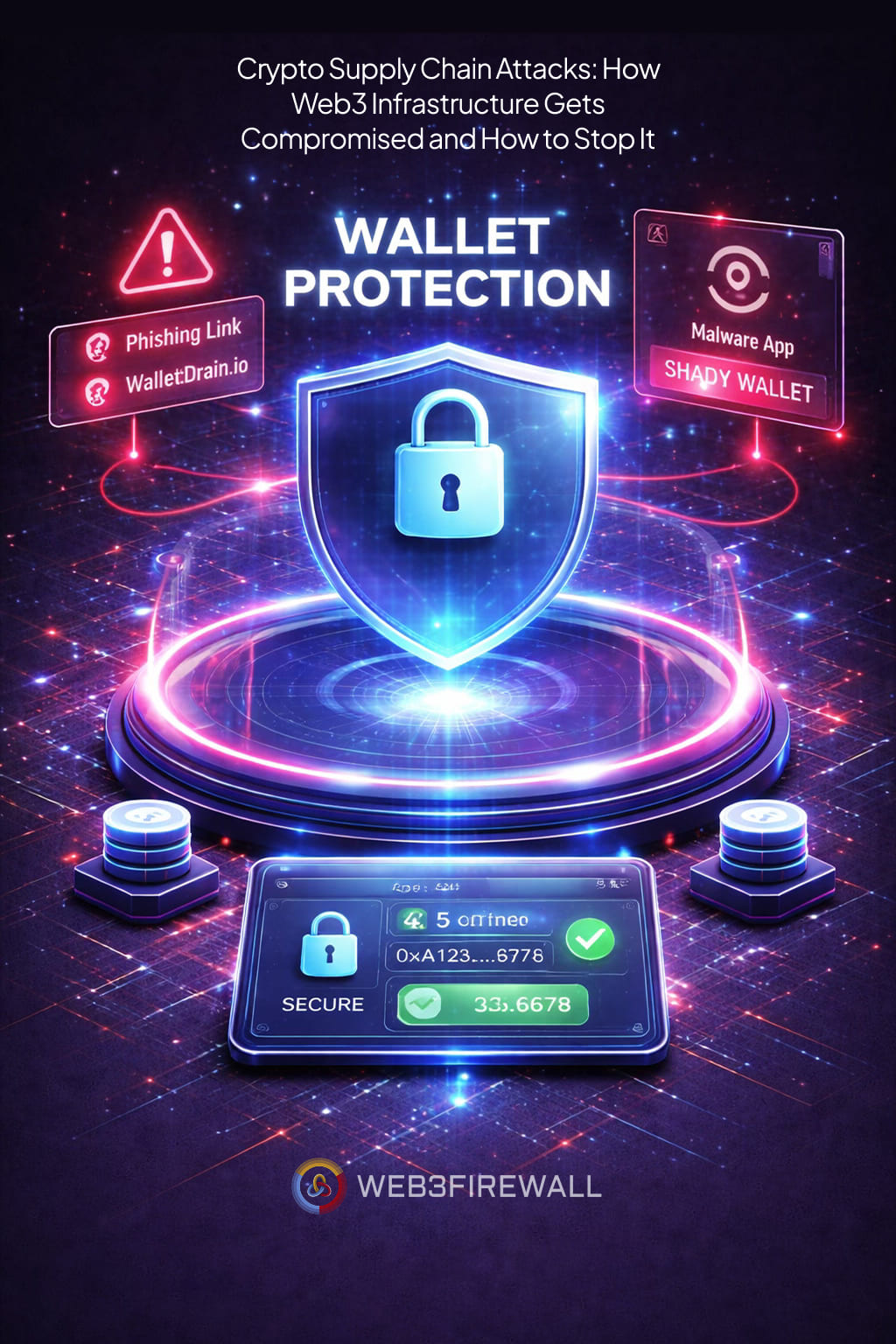
How Web3Firewall Detects Supply Chain Attacks

Web3Firewall's core architecture is designed specifically for the threat model that supply chain attacks represent: a compromise that produces legitimate-looking transactions with malicious outcomes.
The key principle: verify behavior, not source
Web3Firewall does not assume a transaction is safe because it originated from trusted infrastructure. It evaluates what the transaction will actually do. A supply chain compromise that alters a destination address, expands an approval, or modifies a value parameter produces transaction outcomes that deviate from expected protocol behavior — and those deviations are detectable in simulation before execution.
Pre-broadcast transaction simulation
Every transaction is simulated before submission, revealing the actual outcome — asset movements, approval grants, contract state changes — independently of the source that constructed it. If a compromised npm package has modified the transaction, the simulation output reflects the modification.
Behavioral anomaly detection
Baselines are established for normal transaction patterns across protocol operations. Sudden changes in destination addresses, unexpected approval scope expansions, and value flows inconsistent with historical norms are surfaced as risk signals — even when the transaction appears to have originated from a clean source.
Policy engine enforcement
Transactions flagged as anomalous by simulation or behavioral analysis can be automatically held, blocked, or escalated for manual review before broadcast. The policy layer operates on transaction outcomes, not on source metadata.
Continuous infrastructure monitoring
Unusual patterns in transaction construction, RPC response behavior, and approval activity are monitored continuously. Deviations from established baselines trigger alerts before they result in confirmed on-chain losses.
Web3Firewall is the only system that verifies transaction outcomes regardless of source integrity. When the compromise lives in your infrastructure, that distinction is the only one that matters.
In a production deployment, a transaction modified by a supply chain compromise — exhibiting altered destination addresses, anomalous approval parameters, or value flows inconsistent with protocol baselines — would likely trigger policy enforcement before reaching the network, depending on integration and configuration.

Who Needs Supply Chain Attack Protection?

Request a demo

Smart contract and security teams

Supply chain attacks are increasingly the vector of choice precisely because smart contract security has improved. Infrastructure-level threats require infrastructure-level and transaction-level defenses working together.

Exchanges and custodians

Institutional infrastructure depends on shared libraries and tooling. A supply chain compromise affecting your transaction construction layer is a systemic risk to customer funds.

Protocol and dApp teams

Your npm dependencies, frontend delivery infrastructure, and RPC providers are all potential attack surfaces. A single compromised dependency in your build chain can silently affect every user interaction.

DeFi users and traders

You interact with frontends and interfaces you did not build and cannot fully audit. Pre-transaction simulation provides a verification layer that operates independently of the interface you're using.

Compliance and risk teams

A supply chain compromise affecting your institution carries regulatory, reputational, and legal exposure. Pre-transaction controls and audit-ready logging provide the evidentiary trail that post-incident response requires.

Verify Transaction Outcomes. Stop Supply Chain Attacks Before They Execute.

Supply chain attacks compromise your infrastructure before a single transaction fires. Web3Firewall verifies what every transaction will actually do — not where it came from — giving you the only detection layer that works regardless of where the compromise lives.

Frequently Asked Questions

What is a crypto supply chain attack?

A crypto supply chain attack compromises the tools, libraries, infrastructure, or interfaces that a protocol or wallet depends on — rather than attacking smart contract code directly. By infiltrating a trusted dependency such as an npm package, a JavaScript library, or an RPC endpoint, attackers can silently modify transactions before they reach the blockchain, while all source-level checks continue to pass.

What are examples of crypto supply chain attacks?

Common examples include compromised npm packages that replace destination wallet addresses in outgoing transactions; frontend hijacks that modify approval parameters before transactions reach the user's wallet; RPC manipulation that alters transaction data returned to wallets and dApps; and malicious transitive dependencies injected into protocol build tooling during deployment.

Why don't smart contract audits prevent supply chain attacks?

Smart contract audits evaluate whether contract code executes correctly as written. They do not inspect the npm packages, CDN infrastructure, RPC endpoints, or frontend code that sit above the contracts. A supply chain attack compromises that upstream infrastructure — the contracts remain clean, the audit remains valid, and the exploit proceeds undetected at the code level.

How is a supply chain attack different from a wallet drainer?

A wallet drainer targets individual users through phishing or malicious interfaces, requiring each victim to sign a malicious transaction individually. A supply chain attack compromises shared infrastructure — a single compromised dependency can affect every user of every protocol in the dependency graph simultaneously, without requiring individual interaction. Supply chain attacks have a systemic blast radius that wallet drainers do not.

How do you detect a supply chain attack in Web3?

The most reliable detection operates at the transaction layer rather than the source layer. Pre-transaction simulation evaluates what a transaction will actually do — regardless of how it was constructed. Behavioral anomaly detection identifies deviations from expected transaction patterns. These two controls surface supply chain compromises that have already bypassed source integrity checks, because the compromise is visible in transaction outcomes even when it is invisible at the source.

How can protocols prevent supply chain attacks?

Prevention requires layered controls: dependency monitoring to detect unexpected library updates or new maintainer access; transaction simulation to verify outcomes at execution time regardless of source; behavioral anomaly detection to flag deviations from established baselines; pre-broadcast policy enforcement to hold or block anomalous transactions; and frontend integrity monitoring using subresource integrity checks and continuous asset monitoring.